


Artificial intelligence has transformed the way we create content, run businesses, and understand what consumers want. But one of the most surprising shifts in recent years is its entry into influencer marketing.
Yes, we now have influencers who look completely real but do not exist in real life.
From luxury fashion houses to global tech brands and even small local businesses, many companies are now partnering with AI generated influencers. They are affordable, easy to customize, and free from the usual controversies that come with human influencers. But the real question is whether these digital personalities are truly the future of low cost marketing or if the excitement around them is louder than their impact.
Let’s explore this in a clear and beginner friendly way.
What are AI Generated Influencers?
AI generated influencers are virtual personalities created with advanced artificial intelligence and computer generated imagery. They are designed to look and behave like real people, even though every part of them is digitally built. Their appearance, voice, personality, lifestyle, and online presence are all created by technology rather than real life experiences.
These digital influencers can do almost everything human influencers do. They can:
- Share photos and videos on social media
- Engage with followers through comments
- Promote products and services for brands
- Appear in advertisements and marketing campaigns
- Collaborate with real human influencers
- Build loyal audiences and communities
The biggest difference is that AI influencers never get tired, never cancel partnerships, never age, and never fall into unplanned controversies. Their creators control their entire online identity, making them predictable and easy for brands to work with.
Some well known AI generated influencers include:
Lil Miquela, one of the earliest and most successful virtual creators.
Imma, a Japanese AI model known for her fashion focused content.
Shudu Gram, a digital supermodel created by photographer Cameron James Wilson.
Bermuda, an AI influencer with more than two hundred and fifty thousand followers.
Many of these virtual influencers have millions of followers and earn impressive income from brand deals, making them a powerful and growing part of modern digital marketing.
How AI Generated Influencers are Created?
Building an AI generated influencer is a mix of advanced technology, creative design, and strategic storytelling. Every digital creator you see online goes through a multi step process before becoming a believable virtual personality.
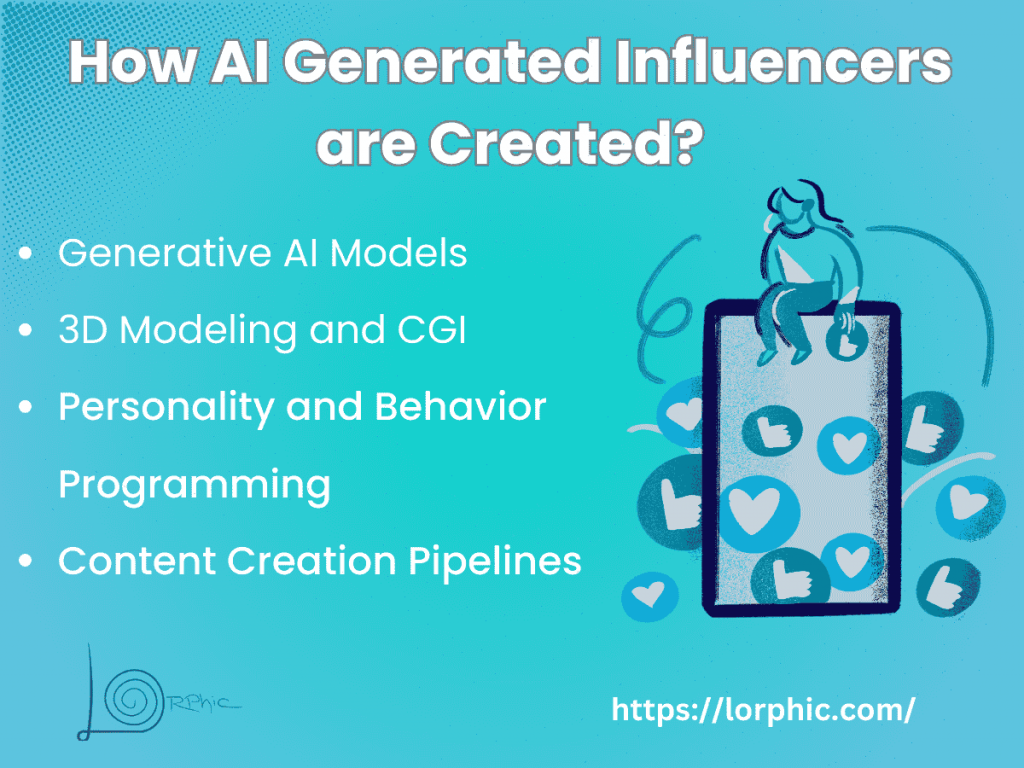
Generative AI Models
The first stage involves using generative artificial intelligence to create the influencer’s appearance, facial expressions, body movements, and overall visual style. High quality image generation models such as advanced Stable Diffusion versions help create realistic photos, while AI video tools bring these characters to life through smooth motion. Voice synthesis technology is also used to give the influencer a natural sounding voice, allowing them to speak in videos, collaborate with brands, or interact with audiences.
3D Modeling and CGI
For brands that want complete control over how an AI influencer looks and moves, designers create a full 3D avatar using professional tools such as Blender, Maya, or Unreal Engine. These detailed digital models allow creators to animate the influencer, change their outfits, adjust their surroundings, and film them in any environment, whether it is a fashion runway or a branded product shoot.
Personality and Behavior Programming
To make an AI influencer feel more human and relatable, developers craft a personality, a tone of voice, and a backstory. They decide how the influencer speaks, the type of content they post, and even their fictional hobbies or life experiences. This helps build a consistent online identity, ensuring the influencer feels engaging rather than robotic.
Content Creation Pipelines
Once the influencer is built, a content creation pipeline handles everything that appears on social media. Teams work on scriptwriting, caption writing, virtual photography, styling, animation, and editing to produce high quality posts. Some companies are now developing fully automated systems where artificial intelligence manages the entire process from concept to final upload, making AI influencers an extremely cost efficient and scalable marketing tool.
Why AI Generated Influencers are Becoming Popular in Marketing?
AI generated influencers are quickly becoming a major trend in digital marketing, especially for brands that want to save money, scale their campaigns, and connect with younger, tech friendly audiences.
- Lower Cost Compared to Human Influencers: Human influencers often charge thousands of dollars for a single post, especially those with large followings. AI influencers can deliver similar results at a much lower cost since they do not require travel, photoshoots, or ongoing management fees.
- Around the Clock Productivity: AI influencers do not need sleep or breaks, which means they can create content nonstop. This helps brands maintain constant engagement across different time zones and platforms.
- No Risk of Scandals or PR Issues: Human influencers can sometimes face controversies that negatively impact the brands they represent. With AI influencers, everything from behavior to messaging is fully controlled, eliminating unexpected public relations problems.
- Complete Customization: Brands can design an AI influencer to match their exact marketing goals. They can adjust appearance, style, tone, and cultural background to appeal to specific audiences or fit unique creative campaigns, including futuristic or fantasy themes.
- Stronger Appeal for the Next Generation: Gen Z and Gen Alpha are already comfortable with digital avatars, virtual worlds, and AI personalities. For them, engaging with an AI influencer feels exciting and modern rather than unusual.
- Easy Global Scalability: AI influencers can instantly adapt to different languages, markets, and cultural settings. This makes it simple for brands to reach worldwide audiences without the limitations human influencers often face.
AI influencers can instantly adapt to different languages, markets, and cultural settings. This makes it simple for brands to reach worldwide audiences without the limitations human influencers often face. Industry analysis highlights that virtual influencers are attractive because they allow brands to create reusable digital personalities, maintain full creative control, reach global audiences without typical logistic constraints, and scale content production more affordably compared to human led campaigns.
How Do AI-Generated Influencers Work?
AI generated influencers function much like human influencers, but everything happens through automation and technology behind the scenes.
Their content is produced using advanced AI tools that can create realistic photos, videos, reels, voiceovers, and even interactive posts. To make these virtual personalities feel real, creators develop storylines, daily life moments, adventures, and collaborations that help build emotional connection with audiences.
Engagement is also handled through automation, where AI analyzes comments, uses prewritten responses, or generates replies in real time to keep conversations active. When brands want to collaborate, they simply provide a brief, and the AI influencer’s team produces content showcasing the product, which is then posted and tracked like any regular influencer campaign.
In simple terms, it is influencer marketing carried out entirely through technology instead of a human creator.
Limitations & Concerns of AI Generated Influencers
AI generated influencers are powerful tools for marketing, but they come with their own set of limitations and concerns.
Lack of Authentic Human Emotion: While AI can imitate emotions, it cannot truly feel them. Many audiences still prefer real human influencers who share genuine experiences and emotions that are relatable.
Ethical and Transparency Issues: Brands need to be clear when an influencer is AI generated. Failing to disclose this can lead to audience distrust or backlash.
Risk of Over-Saturation: As more brands adopt AI influencers, they may lose their uniqueness, and audiences could start seeing them as less exciting or authentic.
Dependence on AI Tools and Agencies: Not every brand has the resources to create and manage an AI influencer internally. Many rely heavily on third party tools or agencies, which can add complexity and cost.
Intellectual Property Questions: Ownership of an AI influencer’s face, voice, and personality can be unclear. Legal and copyright issues are still evolving in this space.
Potential Job Displacement: Traditional human influencers may feel threatened as AI avatars become more common, potentially reducing opportunities for real creators.
AI-Generated Influencers vs Human Influencers: Which is Better?
When it comes to choosing between AI generated influencers and human influencers, there is no one size fits all answer. Each has unique strengths, and the best approach often depends on a brand’s goals and audience.
Where AI Influencers Excel?
AI influencers are ideal for brands looking to save costs and maintain consistency. They can post regularly without breaks, scale campaigns globally, and remain completely scandal free. Brands also have full creative control over their appearance, personality, and content style, making them perfect for high volume content creation or campaigns that require precision and efficiency.
Where Human Influencers Shine?
Human influencers still hold an advantage when it comes to building genuine emotional connections with audiences. Their authentic storytelling, real life experiences, and relatable moments create trust and believability that AI cannot fully replicate. Human unpredictability can also add charm and personality, making content feel lively and memorable.
In short, AI influencers offer efficiency, control, and cost effectiveness, while human influencers bring authenticity, emotional impact, and relatability. Many brands find that combining both approaches can deliver the strongest results.
Final Thoughts
AI generated influencers are more than just a trend. They are becoming a powerful tool for brands looking for affordable, scalable, and fully controlled marketing solutions.
However, they are unlikely to completely replace human influencers. What we are seeing instead is a future where AI and human influencers work together. AI influencers can support campaigns, boost creativity, and lower costs, while human influencers continue to deliver authenticity, emotional connection, and real life relatability.
For brands with tight budgets, AI influencers offer a practical and innovative option. For brands that prioritize trust and genuine audience engagement, human influencers remain essential. The most successful brands will be those that find the right balance, leveraging the strengths of both AI and human creators.
FAQ’s
What are AI generated influencers?
AI generated influencers are virtual personalities created with artificial intelligence, 3D modeling, and CGI. They act like real influencers but are fully computer generated.
Why are AI influencers becoming popular?
They are popular because they offer lower marketing costs, consistent content, full brand control, global reach, and no risk of scandals.
Are AI influencers cheaper than human influencers?
Yes. AI influencers require a one time creation cost and can produce unlimited content, making them more affordable than repeated collaborations with human influencers.
How are AI influencers created?
They are built using generative AI, CGI, 3D modeling, animation, voice synthesis, and scripted personalities to make them relatable and engaging.
Can AI influencers replace human influencers?
Not entirely. AI influencers excel at scalable content and cost efficiency, while human influencers provide emotional connection and real life authenticity.
Curated by Lorphic
Digital intelligence. Clarity. Truth.