

Last updated: March 5, 2026
If your Search Console looks like “nice, impressions are up” but your phone is quieter, welcome to 2026.
AI Overviews are answering the question before people ever reach your website. So how to get cited in Google AI Overviews for local business? Make your service page ridiculously easy to quote: a tight answer up top, a real range (not just “it depends”), the 3 local factors that change that range, and one clear next step. Then prove you’re the real deal with local signals Google can verify fast, like reviews that mention the exact service plus a neighborhood or landmark, consistent Google Business Profile info, and clean LocalBusiness schema.
Key Takeaways (read this first)
- AI Overviews can cut organic CTR hard, even when you “rank #1.” Seer found organic CTR dropped from 1.41% to 0.64% when AI Overviews showed.
- AI Overviews are no longer “just informational.” Semrush reported a shift where informational AIO triggers fell (Jan to Oct 2025), while commercial, transactional, and navigational triggers rose.
- Zero-click behavior is already the default for many searches. SparkToro + Datos showed only 374 clicks per 1,000 US Google searches went to the open web in 2024.
- In 2026, the win for local businesses is often “get cited”, not “get the click.” Google explicitly positions AI experiences as giving users snapshots with links to “dig deeper.”
- The fastest way to earn citations is to build citation-ready blocks on your service pages and align your entities (site + GBP + schema).
Why are local businesses seeing “impressions up, clicks down” in 2026?
Because AI Overviews and other SERP features are answering the question directly on Google, your listing can be visible (impressions) without earning the visit (click). Google has expanded AI Overviews broadly, and the user’s journey is getting compressed into the search results page.
What this looks like in real life (I see it constantly):
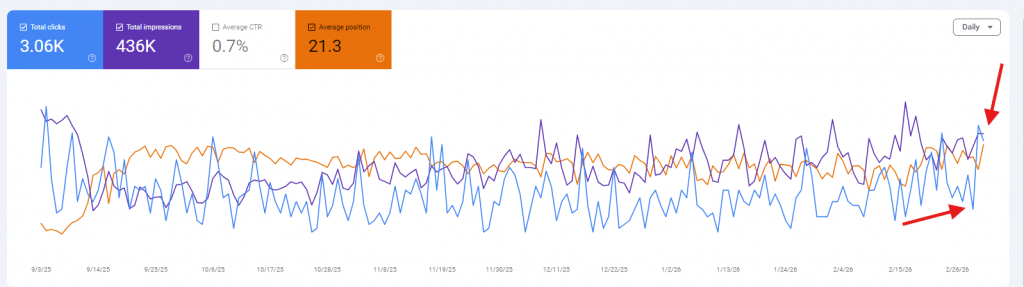
This chart is a common 2026 pattern for local businesses: your brand is showing up a lot more, but fewer people are clicking through. The impressions climbing means Google is surfacing you in more searches, which is good. The drop-off happens because the results page now answers more questions upfront, especially with AI Overviews and local features. So the goal isn’t to panic about rankings. It’s to make sure the moments you do show up, Google has a reason to reference you and send the right kind of leads.
Why it’s happening:
- AI Overviews steal attention above classic organic listings.
- Users get enough confidence from the snapshot to call from GBP, click a directory, or do nothing.
Why do AI Overviews change the value of a #1 ranking?
Because “position” is no longer the top screen priority when an AI Overview is present. Seer’s CTR research showed a major organic CTR drop when AI Overviews appear (their January 2025 analysis found 1.41% to 0.64%).
What to do with that reality:
- Stop celebrating “rankings” alone.
- Start measuring share of AI citations, GBP actions, and lead quality.
Quick gut-check:
- If your best keyword is a “cost / best / vs / worth it” query, assume AI Overviews are siphoning clicks first.
What metric matters more than position for local lead gen now?
The metric that matters is whether your business is cited as a source inside the AI Overview for the questions your buyers actually ask. Google has said AI Overviews include links to sources so people can “dig deeper,” and those source links are becoming the new high-intent real estate.
The local-business twist:
- A citation can create trust even without a click.
- The citation can trigger branded search later (“That Dallas HVAC company Google mentioned…”).
What to track weekly:
- Number of AIO citations (manual checks on a shortlist of queries)
- GBP calls, messages, direction requests
- Branded search lift in Search Console (brand + service combos)
Where do AI Overviews show up most often for local businesses?

They show up heavily on explainers, comparisons, and “decision support” queries, especially when the search implies evaluation or uncertainty. Semrush found AI Overviews expanded beyond purely informational intent through 2025, including more commercial and navigational queries.
Local query patterns that commonly trigger AI Overviews
| Pattern (local) | Example | Why it triggers AIO |
|---|---|---|
| Cost and price ranges | “AC replacement cost Dallas” | Users want a range + factors |
| Best and top | “best caterer near Central Park” | List synthesis and criteria |
| Versus comparisons | “heat pump vs furnace Tampa” | Pros/cons summary |
| Time and process | “how long does a roof replacement take in Dallas” | Step-by-step answers |
| Worth it and risk | “is tankless water heater worth it in Phoenix” | Decision framing |
Your move:
- Build pages that answer these patterns with tight, quotable blocks.
Why is zero-click search the silent killer for local SEO?
Because even when your site is “winning,” the click might not happen. SparkToro and Datos reported that in 2024, only 374 out of 1,000 US Google searches resulted in a click to the open web.
Local SEO implication:
- Google can satisfy intent with AI Overviews + Local Pack + Maps.
- Your “lead” might happen via GBP, not your website.
What this changes for reporting:
- Sessions become a lagging indicator.
- Calls, booked appointments, and branded demand become the truth.
What actually gets pulled into AI Overview citations for local businesses?
Google’s AI features are designed to summarize information and provide links to sources; this favors content that is specific, structured, and easy to extract. Google’s Search Central guidance for AI features basically boils down to: make content that’s helpful, accessible, and clearly structured so it can be used in these experiences.
In practice, citations usually come from:
- A crisp definition or direct answer
- A constrained range (price, timeline, limits)
- A short checklist or process
- A locally grounded “it depends, here’s what changes in your area” section
How do you build “citation-ready” service pages instead of blog fluff?
Start by adding a one-screen answer section near the top of every high-money page: cost, timeline, what’s included, who it’s for, and next step. This is the section AI systems can lift without rewriting your whole page into soup.
The “citation-ready block” layout that tends to win
| Block | What to include | Local example |
|---|---|---|
| 2–4 sentence direct answer | Range + conditions | “In Dallas, AC replacement often ranges from $X–$Y depending on tonnage, ductwork, and permit needs.” |
| Constraints | What changes the outcome | Historic homes in Lakewood vs new builds in Frisco |
| Simple steps | 3–6 steps | “Measure, inspect, quote, permit, install, test” |
| Proof | Reviews, licenses, photos | “Texas TDLR license, permits, before/after installs” |
| Next action | Call, quote, checklist | “Get a same-day load calculation quote” |
Implementation steps (fast):
- Pick 10 services that drive revenue.
- Add the citation block above the fold.
- Add a short “Local factors” subsection (neighborhoods, permitting, weather).
What one section format do AI systems pull from most often?
They pull from sections that read like a clean answer key: definition, ranges, exceptions, and next steps. When your content starts with a direct answer and then expands logically, it becomes easier to cite and harder for competitors to replace.
Write it like you’re answering a stressed-out owner at 2 AM:
- “Here’s the real range.”
- “Here’s what makes it go up.”
- “Here’s what to do next.”
Add local flavor that is not filler:
- Dallas: mention permit timing and summer demand spikes.
- Scottsdale: mention HOA rules and inspection norms.
- Tampa: mention humidity, mold risk, hurricane season scheduling.
Which Google Business Profile assets influence trust the most in 2026?
GBP trust is built by consistency, policy compliance, and real customer feedback. Google’s Business Profile guidelines and help docs emphasize accurate representation and honest reviews practices.
Assets that move the needle for local citations indirectly:
- Primary category accuracy (no “kitchen sink” category stuffing)
- Service areas that match reality
- Photos and short videos that prove you exist and do the work
- Review responses that mention service context (without sounding scripted)
What I’d fix first for a local service business:
- Photos: 20+ real job photos, labeled by service type
- Services: filled out with your top margin services
- Q&A: seed 5–10 real questions customers ask (answered by you)
How do you get reviews that mention neighborhoods and landmarks without sounding weird?
Ask for specifics right after the job while it’s fresh, and make it easy. Google’s guidance allows asking for reviews, but prohibits incentivizing them.
A review request script that works (and feels human):
- “If you mention what we helped with and what area you’re in, it helps neighbors find us.”
Local prompts you can rotate:
- Dallas: “Did we help in Lakewood, Uptown, or Plano?”
- NYC: “Were we near Central Park, Midtown, or the Upper West Side?”
- Tampa: “Were we in Hyde Park, Westchase, or near Bayshore?”
- Scottsdale: “Old Town, McCormick Ranch, or North Scottsdale?”
Important: no incentives, no discounts-for-reviews. That crosses into fake engagement risk.
Schema does not “guarantee” citations, but it reduces ambiguity: who you are, where you serve, what you do. Google’s structured data docs for LocalBusiness outline how to describe your business details for Search.
What schema and entity alignment actually helps AI understand your business?
Minimum schema alignment checklist:
LocalBusinesswith name, address (if applicable), phone, hours- Service pages with clear headings and consistent service naming
- FAQ markup only when it reflects visible on-page content and is not spammy
How do you avoid schema and FAQ spam signals?
Keep it honest, visible, and consistent with user-facing content. Google’s structured data guidance is explicit that markup should reflect what users can see and should follow documented guidelines.
Do:
- Mark up real FAQs that are actually on the page.
- Use plain language, not keyword salad.
Do not:
- Create 40 fake FAQs that never get asked.
- Stuff every city name in a schema field.
Example# Why can a “caterer near Central Park” beat a caterer “in NYC” for AI citations?
Because AI Overviews love specificity. “Near Central Park” signals a tighter entity footprint and higher relevance than a generic “NYC” page that tries to cover everything.
What wins the citation (in catering):
- A short “typical budget ranges by guest count” block
- Venue familiarity (museum events, park permits, delivery timing)
- A constraints section: allergies, staffing ratios, lead times
Example# Why does a Scottsdale realtor beat “Phoenix metro” pages in AI Overviews?
Because broad metro pages often read like directories: vague, repetitive, and not anchored in lived experience. A Scottsdale-focused page can cite school zones, commute patterns, and neighborhood personality in a way that’s extractable and trustworthy.
What to include (without getting cheesy):
- “Who this neighborhood is for” in 3 bullets
- A quick pros/cons table (HOAs, lot sizes, walkability)
- A “questions to ask before touring” checklist
Local specifics that matter:
- Old Town Scottsdale buyer intent differs from North Scottsdale.
- HOA rules and short-term rental restrictions can change the decision fast.
Why do companies lose to directories even when they rank?
Because directories often provide exactly what AI Overviews can summarize: short lists, pricing ranges, and comparison framing. Meanwhile, HVAC sites bury the good stuff under “We’re the best in Dallas” paragraphs.
How to flip it:
- Build a “cost + timeline + what changes price” block.
- Add permit and inspection notes (Dallas-area reality).
- Publish a real “what we check” diagnostic checklist.
What should you track instead of sessions when clicks drop?
Track outcomes that represent real buying intent: calls, direction requests, bookings, and branded demand. Google’s own framing is that AI Overviews provide snapshots with links, and the journey can continue in different ways than a classic click.
A practical KPI stack for local businesses:
- GBP calls and messages
- Form submissions (with source and service captured)
- Branded searches in Search Console
- Quote-to-close rate (because low-quality leads are a hidden cost)
How do you spot when you are cited in AI Overviews?
Do manual spot checks for your top queries and document it like a boring accountant. Pick 10 queries that map to revenue and run them weekly in a clean browser profile.
Steps:
- Search your target phrase (example: “AC replacement cost Dallas”).
- If an AI Overview appears, expand it.
- Look for citations and log:
- Which page is cited
- What text seems quoted
- Who else is cited
Pro tip that saves time:
- Track changes monthly, not daily. AI layouts fluctuate.
What decision framework should you use to prioritize what to fix first?
Use a simple scoring model: Revenue impact + AIO trigger likelihood + citation readiness gap. Semrush data shows AI Overviews expanded across more intent types, so prioritize the queries that have both money and AIO behavior.
The “Fix First” scoring framework (0–3 points each)
| Factor | 0 | 1 | 2 | 3 |
|---|---|---|---|---|
| Revenue impact | Low | Medium | High | Highest |
| AIO likelihood | Rare | Sometimes | Often | Very often |
| Citation readiness | Great | Good | Weak | Terrible |
How to use it:
- Score your top 20 queries.
- Fix the top 5 first with citation blocks + local specifics.
- Re-check citations weekly for 30 days.
FAQs
What is an AI Overview citation in Google Search?
An AI Overview citation is the source link Google shows under its AI-generated summary. It points to pages Google used to build the snapshot.
Do rankings still matter if AI Overviews show up?
Yes, but rankings alone are less predictive of leads. CTR can drop significantly when AI Overviews appear, so citations and GBP actions often matter more.
Are AI Overviews only for informational searches?
Not anymore. Semrush reported AI Overviews expanded into more commercial, transactional, and navigational intent through 2025.
Is it okay to ask customers for Google reviews?
Yes, Google provides guidance on requesting reviews, but you should never offer incentives or pressure customers, since that can be considered prohibited behavior.
Stop Chasing “Position” and Start Owning the Answer
If you take one thing from this, let it be this: in 2026, the local businesses winning are not always the ones “ranking #1.” They’re the ones Google is comfortable quoting. And that’s a different game. It rewards clear answers, real local proof, and pages that don’t dance around the question.
So here’s the move for the next 7 days: pick your top 3 money services, rewrite the top of each page like you’re answering a real customer on the phone, and make the answer impossible to misunderstand. Add a clean range, the local factors that change it, and the next step. Then back it up with signals Google can trust fast: reviews that mention the service and area, consistent Google Business Profile details, and basic schema that matches reality.
If you want a simple way to sanity-check whether this is working, don’t obsess over traffic. Search your main “cost / best / worth it / vs” queries in an incognito window and look at who Google is citing. If it’s not you, you now know what to fix. If it is you, protect it… because competitors will copy the structure the second they notice you’re getting mentioned.
Curated by Lorphic
Digital intelligence. Clarity. Truth.