


Last updated: March 7, 2026
Key Takeaways
Google says there are no special technical requirements for AI features beyond normal Search eligibility, which means there is no secret schema trick that forces AI Overviews to cite your business.
Small businesses still have a real path to visibility in 2026. The winning move is to make your business name, contact details, service area, and site identity easy for Google to understand through clear pages, consistent business details, and supported structured data.
Local AI SEO for small business is now less about chasing one ranking and more about reducing ambiguity. If Google can confidently connect your website, your business profile, and your local service signals, you have a better chance of staying visible when searches become zero-click.
For years, local SEO was easy to explain. Rank the page. Get the click. Turn the click into a call.
That model is weaker now.
Google’s AI features are changing how people discover local businesses. Instead of scanning ten blue links, users can get summaries, follow-up paths, and quick answers before they ever reach a website. Google itself says AI features can help users discover websites they may not have found otherwise, but that also means local businesses are competing in a new layer of visibility where being understood matters as much as being ranked.
Here is the thesis that matters most in 2026:
You cannot force Google’s AI to cite your business. You can make your business the easiest local entity to identify, trust, and surface.
That one shift changes everything.
Why are Google AI Overviews hurting local clicks?
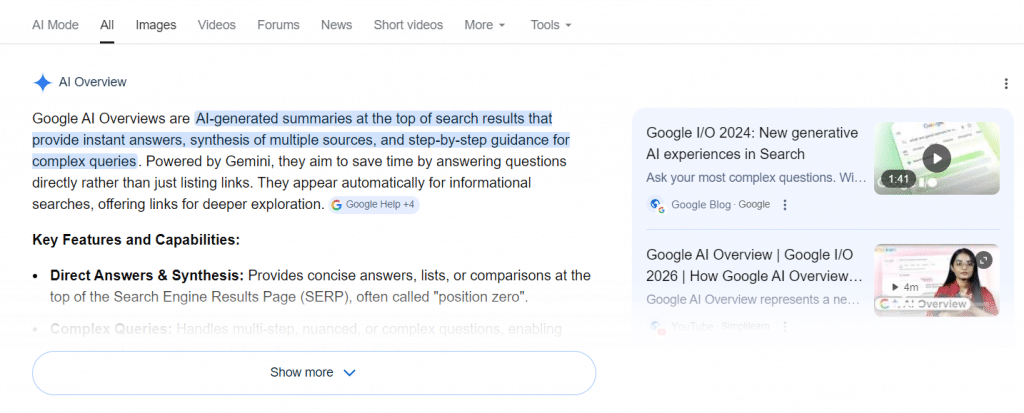
AI Overviews can answer simple local questions without sending the searcher to your site right away. That does not mean your business is invisible, but it does mean fewer people may click through the old way, especially for basic queries about services, hours, business types, and comparisons. Google positions AI features as part of Search discovery, not as a separate search engine, so local businesses need to adapt to how visibility is earned inside that broader experience.
What gets lost here is that small businesses often treat traffic as the only score. It is not. In a zero-click environment, your business still wins when Google clearly understands who you are, where you operate, what you offer, and why you are relevant to the query.
That means local SEO can no longer stop at rankings.
Why can’t small businesses rely on rankings alone anymore?
Because rankings measure page position, while AI-led visibility depends on page position plus business understanding. Google’s documentation on AI features says standard Search technical requirements still apply, but it also explains that AI features create new ways for users to find websites. In practice, that means a business can be relevant to an answer journey without winning the exact classic ranking marketers used to obsess over.
A plumber in Tampa, a wedding caterer in Charleston, or a family dentist in Plano does not just need a page that ranks. They need a website and business footprint that clearly tells Google, “This is the official business, this is the phone number, this is the service area, and this is what we actually do.”
That is where local AI SEO for small business becomes less about tricks and more about entity clarity.
What does Google need to understand about your local business?
Google needs a clean, consistent picture of your business identity. Its documentation on business details, site names, and LocalBusiness markup all point to the same idea: the more consistent your business information is across your website and the web, the easier it is for Google to display the right details in Search, Maps, and related experiences.
At minimum, Google should be able to understand:
- your exact business name
- your phone number
- your address or service area
- your business category
- your website’s official site name
- your hours
- your core services
- your relationship between service pages and location relevance
Here is the simpler version.
| What Google needs | Where you should show it |
|---|---|
| Official business name | Homepage, footer, title tags, WebSite markup, GBP |
| Phone number | Header, contact page, footer, LocalBusiness markup |
| Address or service area | Contact page, footer, LocalBusiness markup, GBP |
| Business type | Homepage copy, service pages, structured data |
| Site name | Homepage, WebSite markup, visible branding |
| Hours and contact options | Contact page, LocalBusiness markup, business details |
These are not glamorous fixes. They are the kind that actually move the needle.
Which schema types actually matter in 2026?
The most useful schema for local businesses in 2026 is not exotic. It is the supported, boring, high-clarity kind: LocalBusiness, Organization, and WebSite, with page-level schema added only when it truthfully reflects visible content. Google’s structured data guidance is very clear that markup should match the page and that supported formats help Google understand the content more effectively.
Here is what matters most:
| Schema type | Best place to use it | What it helps clarify |
|---|---|---|
| LocalBusiness | Homepage or main location page | Name, address, phone, hours, area served |
| Organization | Homepage | Official business identity and contact details |
| WebSite | Homepage | Site name and alternate site name |
| Service | Relevant service pages | What service is offered and by whom |
| FAQPage | Only where visible FAQs exist | Direct answer structure for supported content |
The important nuance is this: schema helps Google understand. It does not override quality, relevance, or Search rules.
Can schema force Google AI to cite your phone number?
No. That is the myth that needs to die.
Google says there are no extra technical requirements for AI features beyond normal Search requirements. It also says structured data helps Google understand content and can help pages display in richer features. None of that equals “Google AI has to cite my business name and phone number in the summary.”
This matters because bad SEO advice spreads fast, especially when panic sets in. Small businesses hear “zero-click” and immediately look for a code fix. But the real opportunity is stronger than that. Schema can reduce ambiguity. It can reinforce who you are. It can make your business details easier to process consistently. That is valuable precisely because it is realistic.
So the promise should be honest:
Schema does not force AI citation. It improves your chances of being clearly understood.
That is better marketing and better SEO.
What should a local business homepage include right now?
Your homepage should answer four questions fast: who you are, what you do, where you serve, and how to contact you. Google’s guidance on business details and site names supports this kind of clarity, and its title link guidance also reinforces the value of accurate page labeling.
A strong local homepage should include a visible business name, a short service statement, a phone number near the top, a clear service area or primary city, and internal links to key service and location pages. It should also support that visible content with LocalBusiness, Organization, and WebSite markup.
Here is the homepage reality most businesses avoid: if a human lands on your page and still cannot tell whether you serve Phoenix or Philadelphia, Google has the same problem.
How should service pages be written for AI visibility and local trust?
Start with a direct answer, then add useful specifics. That works for users, featured-snippet style formatting, and AI-friendly clarity. Google’s SEO Starter Guide says you should create helpful, reliable, people-first content, and its guidance on generative AI content warns against producing large volumes of pages without real value.
That means your service page should not open with vague lines like “We provide quality solutions for all your needs.” It should sound like a real business talking to a real local customer.
A better opening looks like this:
“Emergency roof repair in Tampa for storm leaks, missing shingles, and same-day inspections. If your roof started leaking after a Gulf Coast downpour, we help homeowners across South Tampa, Carrollwood, and Westchase figure out the next step quickly.”
That kind of copy does three things. It answers the query. It establishes local relevance. It sounds like it came from someone who actually works in the market.
A strong service page usually includes a direct opening answer, local references that are naturally relevant, clear service descriptions, trust signals, FAQs, and contact options that reduce friction.
What mistakes are causing small businesses to disappear from AI-led search?
The most common mistakes are not advanced. They are foundational.
Small businesses disappear from AI-led local search when their site sends mixed signals. Their business name varies by page. Their phone number is buried. Their Google-facing business details do not line up with the website. Their city pages read like thin templates. Their structured data is missing, broken, or does not match visible content. Google’s structured data policies and business details documentation both support the importance of consistency and accuracy here.
This is where a lot of “AI SEO” talk falls apart. Many sites are trying to solve a local identity problem with more content. But if the foundation is muddy, more pages only multiply the confusion.
Here is the practical diagnostic table:
| Problem | What it signals to Google | Better fix |
|---|---|---|
| Inconsistent business name | Unclear entity identity | Standardize your brand name everywhere |
| Missing phone number in key areas | Weak business detail clarity | Add it to header, footer, contact page, markup |
| Thin city pages | Low value or duplicate intent | Consolidate and rewrite with real local specifics |
| No site name markup | Weak site identity support | Add WebSite markup and align branding |
| Broken or mismatched schema | Low trust in markup | Validate and make it match visible content |
What should a small business do this week?
Fix the identity layer first.
That means auditing the homepage, contact page, business profile details, top service pages, and structured data before you think about publishing ten new blog posts. Google’s Rich Results Test and Schema Markup Validator can help check whether your markup is present and valid, while Search Console remains essential for understanding how Google sees your pages.
A smart weekly action plan looks like this:
- Standardize your exact business name across the website and profiles.
- Make the phone number visible in the header, footer, and contact page.
- Add or correct LocalBusiness, Organization, and WebSite markup.
- Rewrite the intro of your top three service pages so they answer the query directly.
- Remove or improve thin location pages.
- Review your Google-facing business details for consistency.
- Scan real customer questions from calls, emails, reviews, and community discussions such as Reddit, then turn those into direct-answer FAQs on your most important pages.
That is not flashy. It is what a real small business can actually implement.
What is the decision framework for local AI SEO in 2026?
If your business is easy to understand, invest in better coverage. If your business is hard to understand, fix clarity first.
| Situation | First move |
|---|---|
| Rankings are weak and pages are thin | Improve page quality and people-first content |
| Rankings are decent but calls are falling | Strengthen business details and conversion clarity |
| AI visibility feels weak | Audit entity consistency, site naming, and service-area signals |
| Location pages are bloated | Consolidate and keep only useful, specific pages |
| Schema is missing | Add supported markup before scaling content |
This is the pivot most small businesses need. Not more noise. More clarity.
FAQs
What is local AI SEO for small business?
Local AI SEO for small business is the process of making your business easier for Google to understand and surface in AI-driven local search experiences. It focuses on clear business details, supported schema, useful service pages, and consistent site identity.
Can Google AI Overviews reduce website traffic for local businesses?
Yes, especially for simpler local queries that can be answered directly in Search. Google frames AI features as another discovery layer, which means visibility may still happen even when the click path changes.
Does LocalBusiness schema guarantee AI visibility?
No. LocalBusiness schema helps Google understand your business details, but it does not guarantee inclusion in AI Overviews or any other Search feature.
What matters more in 2026, rankings or business clarity?
Both matter, but business clarity is becoming more important in zero-click and AI-assisted search journeys because Google needs to confidently understand who you are before it can surface you well.
How can a small business improve local AI visibility fast?
Start by fixing business name consistency, visible contact details, supported structured data, top service page intros, and Google-facing business details. Then expand with stronger location and FAQ content.
Google AI Overviews are not just stealing local clicks. They are changing what local visibility means.
Final takeaway
That is the part many businesses are still missing.
The businesses that survive this shift will not be the ones chasing a fake AI citation hack. They will be the ones that make their identity, service area, and credibility so clear that Google has very little left to guess about. That is what local AI SEO for small business looks like in 2026. It is not magic. It is not a loophole. It is a cleaner, smarter version of local search strategy built for the way discovery now works.
Soft conversion strategy:
If your rankings look decent but your business still is not showing up where local buying decisions start, the problem may not be rankings at all. It may be that Google still does not fully understand your business as a local entity. That is the gap a local AI SEO audit should uncover.
Curated by Lorphic
Digital intelligence. Clarity. Truth.