

Choosing an AEO agency in Connecticut is more difficult than choosing an SEO agency because the category is newer, measurement standards are still developing, and many providers are simply repackaging existing SEO services under AI-adjacent terminology. For a business in Fairfield, West Hartford, or Greenwich evaluating options, the challenge is not finding agencies that claim to do answer engine optimization it is separating those with a genuine, documented process from those offering SEO dressed in new language. This guide explains what to look for, what to ask, how to evaluate deliverables, and what warning signs should end a conversation.
Key Takeaways
- A legitimate AEO agency should be able to explain specifically how its work differs from traditional SEO, demonstrate a prompt-testing measurement protocol, and show you anonymized results from existing clients
- No agency can guarantee AI citations in ChatGPT, Perplexity, or Google AI Overviews any such guarantee is a misrepresentation of how these systems work
- The most valuable early engagement is usually an AEO audit before committing to a retainer it gives you a documented baseline and a prioritized gap list
- Pricing for AEO work in the Connecticut market reflects scope, not volume cheaper plans typically skip human review, reporting, and the corroboration-building work that actually moves citation frequency
- Connecticut’s business markets vary significantly: a Greenwich financial advisory firm and a Guilford home services contractor face different AEO needs, competitive contexts, and realistic timelines
- Before evaluating any agency, confirm that your business’s traditional SEO foundation is working AEO builds on that foundation and underperforms without it
What a Legitimate AEO Agency Actually Delivers
Before interviewing any provider, understand what genuine AEO work involves. A credible AEO agency in Connecticut delivers specific, documented outputs not vague improvements to AI visibility.
The core deliverables of a legitimate engagement, as covered in our AI visibility services include an entity consistency audit with corrections across all platforms where the business appears, a review of robots.txt for AI crawler access (GPTBot, ClaudeBot, PerplexityBot), a content audit and restructuring plan that identifies which pages can be rewritten for AI extractability, Google Business Profile optimization specific to AI data sources, and a documented prompt-testing baseline showing current citation frequency across ChatGPT, Perplexity, and Google AI Mode.
An agency that cannot enumerate these deliverables specifically, or that describes its AEO work in the same terms it would use to describe traditional SEO content improvement, is likely offering the same product under a different name.
The AEO Audit: Why It Should Come Before a Retainer
For most Connecticut businesses, the right first engagement with any AEO provider is a standalone audit rather than an immediate monthly retainer commitment. An audit answers the specific question: what is your current AI search visibility position, where are the gaps, and what would have the highest commercial impact if fixed first?
A credible AEO audit covers:
- A prompt-testing baseline 20 to 30 queries run across ChatGPT, Perplexity, and Google AI Mode representing how your customers search for your service type in your Connecticut geography
- An entity consistency review identifying every discrepancy in how your business appears across Google, Apple Maps, Yelp, data aggregators, and relevant directories
- A technical accessibility check confirming AI crawlers are not blocked and schema markup is correctly implemented
- A content extractability assessment of your top service pages whether they are structured to provide the direct, question-answering format AI systems use to generate cited responses
- A competitive context assessment showing which competitors currently appear in AI answers for your category
For a law firm in West Hartford or a financial advisory practice in Greenwich, this audit typically costs $300 to $700 from a competent provider and takes one to two weeks. It is worth paying for before any retainer commitment because it produces a documented baseline that you own independently, making any future provider accountable to a starting point you verified.
If an agency will not offer a standalone audit and pushes directly to a multi-month retainer, note that. It may reflect confidence in their process or it may reflect reluctance to have you see the actual starting point before billing begins.
Questions to Ask Before Hiring
These questions reveal whether an AEO agency has a genuine, differentiated process or is relabeling SEO.
“How does your AEO content work specifically differ from your standard SEO content?”
The answer should describe concrete structural differences: question-based headings, direct-answer leads in the first sentence of each section, FAQ sections with FAQPage schema markup. A provider who responds with general references to content quality, keyword usage, or topical authority is not describing AEO content specifically.
“What is your prompt-testing protocol and what does the monthly report include?”
Prompt testing running defined queries across multiple AI platforms and documenting citation frequency is the primary measurement tool for AEO performance. An agency without a documented protocol for this is not measuring AI visibility. The monthly report should show: which queries your business now appears in, whether citations are named or ghost (source-only), and how citation frequency has changed from the baseline. An agency that reports only traditional rankings and organic traffic is running a traditional SEO program.
“Can you show me AI Overview impression trends from a current client’s Search Console?”
Google Search Console now reports AI Overview impressions separately from organic impressions. A provider with active AEO clients should be able to share anonymized trend data showing measurable movement. If they cannot produce this, they either do not have clients whose programs are working or they are not measuring AEO performance specifically.
“What is your entity audit process and how do you handle data aggregator corrections?”
The four major data aggregators Foursquare, Data Axle, Localeze, Acxiom feed hundreds of downstream directories. An AEO agency doing complete work corrects primary platforms and the aggregators, not just the most visible ones. A provider who has never heard of these aggregators or dismisses them is doing partial work on a foundational requirement.
“What happens to all work product and account access if the engagement ends?”
Every piece of content produced for your site, all schema markup, all GBP optimizations, and all account access should transfer to you in full when the engagement ends. Any provider who retains content ownership or manages your accounts under their credentials is building dependencies that benefit them at your expense.
Evaluating AEO Proposals: A Scoring Framework
When comparing proposals from multiple Connecticut AEO providers, score each on these criteria. Use 0 (no), 1 (partial), or 2 (yes, clearly). Maximum: 18.
| Criterion | What you are looking for |
|---|---|
| Explains AEO vs SEO distinction specifically | Can articulate the content structure and measurement differences |
| Offers a standalone audit before retainer | Not required, but a strong positive signal |
| Documents prompt-testing protocol | Has a defined, repeatable measurement method |
| Shows GSC AI Overview data from current clients | Evidence of measurable results |
| Deliverables fully itemized in proposal | No vague scope language |
| Reporting includes citation frequency, not just traffic | AI-specific measurement in monthly reports |
| No guarantee language | Zero promises about specific AI placements |
| Work product and account access transfer on exit | Written into the agreement |
| Entity audit covers aggregators, not just primary platforms | Demonstrates understanding of full citation ecosystem |
Scores of 16 to 18 indicate a strong candidate. Scores of 10 to 15 warrant clarifying questions before signing. Scores below 10 indicate the provider is likely not running a genuine AEO program.
Pricing and What It Reflects
AEO pricing in the Connecticut market reflects scope, not just time. A credible engagement for a Connecticut small business typically falls into these ranges:
A one-time audit and baseline runs $300 to $700. A foundational setup engagement entity corrections, GBP optimization, technical accessibility fixes, schema implementation, and content restructuring of the top five service pages runs $800 to $1,500 as a one-time project. Ongoing AEO management, including monthly prompt testing, content maintenance, corroboration-building outreach, and monthly reporting, runs $500 to $1,500 per month depending on market competition and content scope.
These are market estimates, not guarantees. Actual pricing varies by provider, scope, site complexity, and competitive context. Always request an itemized proposal.
Be appropriately skeptical of both ends of the pricing range. AEO programs below $300 per month typically involve automated processes with no human review and no genuine prompt-testing measurement. Proposals at $3,000 per month or more without a detailed deliverables breakdown deserve line-by-line scrutiny premium pricing may be justified, or it may reflect agency overhead rather than expanded scope.
For Fairfield County markets like Greenwich and Fairfield itself where professional service category competition is high and the buyer base is research-intensive the full-service end of these ranges is often appropriate. For a Guilford home services business in a lower-competition coastal market, the foundational setup plus a basic ongoing retainer is typically sufficient.
Warning Signs That Should End the Conversation
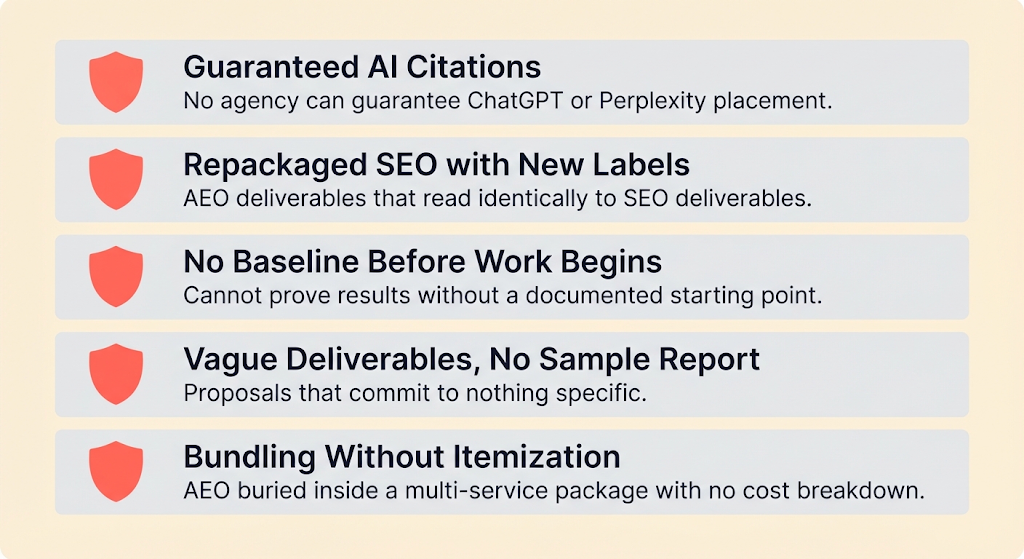
Guaranteed AI citations. No agency can guarantee placement in ChatGPT, Perplexity, or Google AI Overviews. Per Google’s Search Central documentation, AI Overviews are generated algorithmically. Any agency claiming they can guarantee your business appears in these answers is misrepresenting how the systems work.
Repackaged SEO with new terminology. If an agency’s AEO proposal describes the same deliverables as their SEO proposal keyword research, content optimization, link building, rank tracking with “AI” added to the section headings, they are not running a genuine AEO program. Ask what specifically changes in their process for AEO versus SEO.
No measurement baseline before work begins. An AEO program without a prompt-testing baseline cannot demonstrate that it produced any results. If a provider will not establish where you currently stand in AI search before beginning work, you have no way to evaluate whether the engagement is producing movement.
Vague deliverables and no sample report. Proposals that describe “improving your AI visibility” without specifying exactly what will be done, at what frequency, and how it will be measured are not service descriptions they are commitments to nothing specific. Ask to see a sample monthly report from a current client before signing.
Bundling without itemization. An AEO retainer that also includes “SEO, social media management, content creation, and paid advertising” without separating each component’s scope and cost makes it impossible to evaluate what you are actually paying for AEO specifically.
Realistic Timelines for Connecticut Businesses
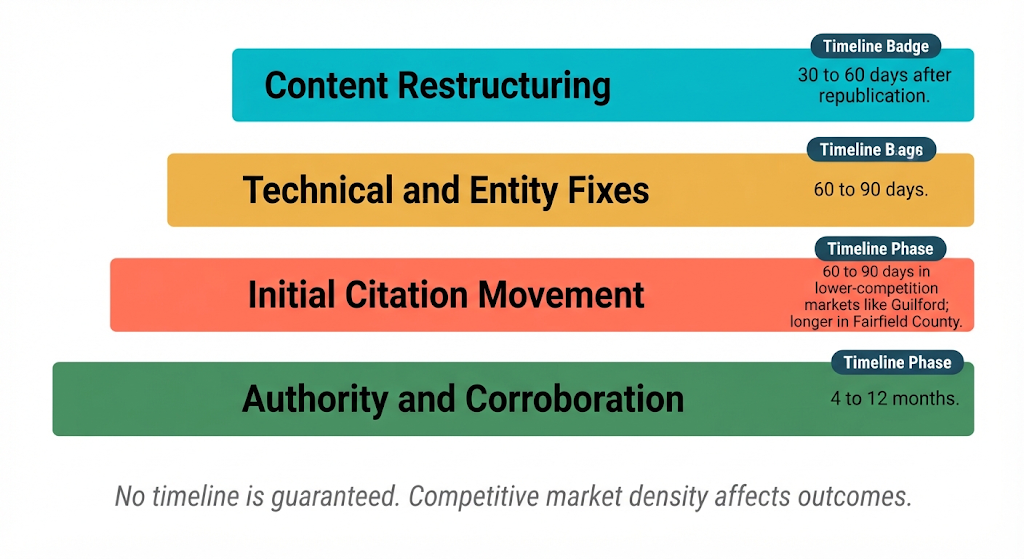
Entity and technical fixes typically produce measurable AI citation movement within 60 to 90 days. Content restructuring of service pages takes effect within 30 to 60 days of republication. Third-party corroboration building the earned media and directory presence work that AI systems use as trust evidence takes 4 to 12 months to produce compounding results.
These timelines apply across Connecticut markets, but the starting point matters. A West Hartford healthcare practice that already has strong local SEO, consistent citation data, and active review velocity will see AEO improvements faster than one starting from scratch across all these signals.
A Greenwich financial advisory firm entering AEO with a clean foundation in a high-competition Fairfield County market should expect 4 to 6 months before consistent named citations in AI answers for their primary query categories. A Guilford contractor in a lower-competition coastal market with a similar foundation may see that same outcome in 60 to 90 days. Neither timeline can be guaranteed they are realistic expectations based on typical signal accumulation patterns.
For the full framework on what AEO services include and how the work unfolds month by month, see AEO Services for Connecticut Businesses: How to Get Found in AI Search
FAQs
How is an AEO agency different from an SEO agency?
A genuine AEO agency in Connecticut optimizes for AI search citation frequency how often your business appears in ChatGPT, Perplexity, and Google AI Overviews. Traditional SEO targets organic rankings. Both overlap in technical foundations but diverge in content structure, authority signals, and measurement. An agency doing both should articulate these differences specifically.
What should an AEO audit include?
A credible audit covers: a prompt-testing baseline across ChatGPT, Perplexity, and Google AI Mode; an entity consistency review across platforms and data aggregators; technical AI crawler accessibility; content extractability of top service pages; and a competitive context review. It should produce a prioritized gap list and a documented baseline.
Can an AEO agency guarantee AI citations?
No. AI Overviews, ChatGPT, and Perplexity generate answers algorithmically. Any agency claiming guaranteed placement is misrepresenting how these systems work.
What does AEO cost in Connecticut?
Audits run $300 to $700. Foundational setup runs $800 to $1,500 one-time. Ongoing management runs $500 to $1,500 per month. These are estimates always request an itemized proposal.
How long before I see AEO results?
Technical and entity improvements produce measurable citation movement in 60 to 90 days. Content restructuring takes 30 to 60 days. Authority building takes 4 to 12 months. Lower-competition markets like Guilford typically see earlier results than dense Fairfield County markets.
What if an agency cannot show results from current clients?
Ask for anonymized Search Console AI Overview impression trends from any comparable client. If a provider cannot produce evidence of measurable AEO impact, either their program lacks results or lacks measurement infrastructure. Either warrants looking elsewhere.
Conclusion
Choosing the right AEO agency in Connecticut comes down to three things: can they explain specifically what they do and how it differs from SEO, can they show you evidence of measurable results, and can they document every deliverable and measurement before you sign anything.
The agencies worth hiring are ones that start with an audit, establish a documented baseline, deliver specific itemized work each month, and report on citation frequency using prompt testing and Search Console AI data not ones that offer guarantees they cannot keep or deliverables too vague to evaluate.
If you want to understand what a legitimate AEO engagement looks like for your specific Connecticut business and market, Lorphic builds and manages AEO programs across the state. Current options at lorphic.com/deal.
Curated by Lorphic
Digital intelligence. Clarity. Truth