

DeepInfer is the high-performance inference framework that powers DeepSeek’s production AI services, open-sourced on October 20, 2026 under the Apache 2.0 license. According to SiliconANGLE’s coverage, the release gives the open-source community direct access to the same infrastructure that serves DeepSeek’s API traffic, including optimizations for DeepSeek-V4.1-Flash on NVIDIA SM100 GPUs and Huawei Ascend 950 NPUs. The repository crossed 10,000 GitHub stars within days of release.
Why this matters beyond the developer community: inference (the process of generating responses from a trained AI model) is where the majority of AI operating costs live. Training a model is a one-time expense. Running it for millions of users is an ongoing cost that scales with every query. DeepSeek has described reaching a massive user base at a reasonable price as “the core problem an inference framework has to solve.” By open-sourcing the engine that solves this problem for their own production services, DeepSeek is effectively giving competitors, cloud providers, and enterprises the blueprints for cheaper AI deployment.
Key Takeaways
- DeepInfer is DeepSeek’s production inference engine, now open-sourced under Apache 2.0. It is the same code that powers DeepSeek’s own API services, not a simplified external version.
- The framework currently supports one model: DeepSeek-V4.1-Flash. It runs on NVIDIA SM100 GPUs and Huawei Ascend 950 NPUs.
- According to DEV Community’s technical analysis, the release crossed 10,000 GitHub stars within days, signaling significant developer interest.
- DeepInfer uses DSpark speculative decoding (5-token drafting with confidence prediction) and builds on previously released components: FlashMLA, DeepGEMM, and DeepEP kernel libraries.
- This is not a complete serving solution. Users must supply their own KV cache system, prefill/decode disaggregation, and load balancing for production deployment.
- For businesses using AI in marketing, content, and customer service, lower inference costs mean cheaper AI-powered tools and services over the next 12 to 24 months.
Table of Contents
- What Is DeepInfer?
- Why Did DeepSeek Open-Source Its Inference Engine?
- 5 Key Technical Features of DeepInfer
- What DeepInfer Does Not Include
- How DeepInfer Compares to Other Inference Frameworks
- What This Means for Businesses Using AI
- Decision Framework: Who Should Care About DeepInfer?
- How Lorphic Leverages AI Infrastructure Advances
- FAQs About DeepInfer
What Is DeepInfer?
DeepInfer is the inference framework that DeepSeek uses to serve its own AI models in production. Inference is the process of taking a trained AI model and generating outputs (text, code, analysis) in response to user queries. It is the runtime engine, not the model itself. Think of it this way: if the AI model is the brain, the inference engine is the body that makes the brain function efficiently at scale.
According to Quartz’s reporting, the framework supports DeepSeek-V4.1-Flash and runs on NVIDIA SM100 GPUs and Huawei Ascend 950 NPUs. DeepSeek released the code under the Apache 2.0 license, which allows commercial use, modification, and redistribution without restriction.
What makes this release significant: this is not a demo or a research prototype. This is the actual production code serving DeepSeek’s API traffic. According to the DEV Community analysis, DeepSeek explicitly stated that the release “provides offline inference with the core features needed for serving at scale.” The same code that handles millions of DeepSeek queries is now available for anyone to study, modify, and deploy.
Why Did DeepSeek Open-Source Its Inference Engine?
DeepSeek’s decision to release its production inference engine follows a pattern the company has established throughout 2026. According to Yahoo Finance’s coverage, the release adds to a series of open-source projects from DeepSeek, which has previously released models, kernel libraries (FlashMLA, DeepGEMM, DeepEP), and now the framework that ties them together.
Three strategic reasons explain the move:
Ecosystem building. By making its inference infrastructure open, DeepSeek encourages developers, cloud providers, and enterprises to build on its technology. More deployment of DeepSeek-compatible infrastructure means a larger ecosystem for DeepSeek models, which reinforces the company’s position in the AI market.
Competitive pressure on proprietary providers. OpenAI and Anthropic run proprietary inference stacks. When the performance gap between open-source and proprietary inference narrows, the justification for proprietary pricing weakens. Open-sourcing production-grade inference code applies direct competitive pressure.
Talent recruitment and community trust. Releasing production code demonstrates engineering capability and builds credibility in the developer community. The 10,000+ GitHub stars within days of release signal that the strategy is working.
5 Key Technical Features of DeepInfer
1. DSpark speculative decoding
DSpark is a speculative decoding system where a smaller draft model proposes 5 tokens at a time and a confidence head predicts which tokens the main model will accept. This technique increases token generation speed by reducing the number of times the full model needs to run. For businesses, faster inference means lower cost per query and faster response times.
2. Built on previously released kernel libraries
DeepInfer integrates FlashMLA (memory-efficient attention), DeepGEMM (optimized matrix multiplication), and DeepEP (expert parallelism for Mixture-of-Experts models). These components were individually open-sourced earlier in 2026. The framework ties them into a cohesive production system.
3. Dual hardware support from day one
The release supports both NVIDIA SM100 GPUs and Huawei Ascend 950 NPUs. According to DEV Community’s analysis, Ascend support sitting next to NVIDIA from day one is unusual for a top-tier inference release. This dual-hardware approach reduces dependency on any single chip vendor.
4. Kimi Delta Attention-compatible architecture
The framework supports attention mechanisms optimized for Mixture-of-Experts models, where only a fraction of model parameters activate per token. This architecture is what allows models like DeepSeek-V4.1-Flash to maintain low inference costs despite having trillions of total parameters.
5. Apache 2.0 licensing
The Apache 2.0 license allows commercial use, modification, and redistribution. Enterprises can deploy, customize, and build products on top of the framework without licensing fees or restrictions. This is the most permissive license commonly used for production software.
What DeepInfer Does Not Include
According to DeepSeek’s own documentation, the release provides offline inference but leaves out several components needed for a complete production serving system.
| Included in DeepInfer | Not Included (User Must Supply) |
|---|---|
| Core inference engine | KV cache management system |
| DSpark speculative decoding | Prefill and decode disaggregation |
| FlashMLA, DeepGEMM, DeepEP kernels | Load balancing across replicas |
| NVIDIA SM100 + Huawei Ascend support | Online serving layer (HTTP endpoints) |
| deepseek-recipe (token encoding/decoding) | Monitoring and logging |
| Apache 2.0 license | Older GPU architecture support (Hopper, etc.) |
This means deploying the framework in production requires engineering expertise beyond downloading and running the code. It is production-ready infrastructure for teams that already operate AI serving systems, not a plug-and-play solution for non-technical businesses.
How DeepInfer Compares to Other Inference Frameworks
| Feature | DeepInfer | vLLM | TensorRT-LLM | Triton Inference Server |
|---|---|---|---|---|
| Developer | DeepSeek | UC Berkeley / Community | NVIDIA | NVIDIA |
| Primary focus | DeepSeek model family | General-purpose LLM serving | NVIDIA GPU optimization | Multi-framework serving |
| Speculative decoding | DSpark (5-token draft) | Available | Available | Via backend integration |
| Hardware support | NVIDIA SM100 + Huawei Ascend | NVIDIA (broad GPU support) | NVIDIA only | NVIDIA + some CPU |
| Model support | DeepSeek-V4.1-Flash only | 100+ model architectures | NVIDIA-optimized models | Multiple frameworks |
| License | Apache 2.0 | Apache 2.0 | Apache 2.0 | BSD 3-Clause |
| Production proven at scale | Yes (DeepSeek’s own API) | Yes (many production deployments) | Yes (enterprise deployments) | Yes (enterprise deployments) |
| Best for | DeepSeek model deployment | Broad LLM serving needs | Maximum NVIDIA GPU performance | Multi-model production serving |
The key distinction: most inference frameworks aim for broad model compatibility. DeepInfer is purpose-built for DeepSeek’s model architecture. It trades generality for optimization depth. For teams deploying DeepSeek models specifically, it delivers superior performance. For teams running diverse model portfolios, general-purpose frameworks like vLLM remain more practical.
What This Means for Businesses Using AI
Most businesses will never deploy their own inference engine. But the open-sourcing of production AI infrastructure affects businesses indirectly through 3 channels.
Lower AI service costs. When inference becomes cheaper to operate, AI-powered services (chatbots, content tools, analytics platforms) become cheaper to offer. According to Yahoo Finance, the economic implications are particularly notable for cloud hosting providers and enterprises deploying AI models. Those cost reductions eventually reach end users through lower subscription prices and API fees.
More AI tool competition. Open-source inference engines enable startups and smaller companies to build AI-powered tools without the infrastructure investment that previously required venture capital funding. More competition means more options and better pricing for businesses purchasing AI marketing, content, and customer service tools.
Faster AI capability advancement. When production-grade infrastructure is open, the entire AI ecosystem can build on proven foundations rather than reinventing them. This accelerates the pace at which AI tools improve, which means businesses that adopt AI workflows today will see their tools get meaningfully better every 6 to 12 months.
For small businesses using AI for marketing, content creation, social media management, and customer support, the practical takeaway: the AI tools you use are about to get cheaper and better because the infrastructure powering them is becoming open and competitive.
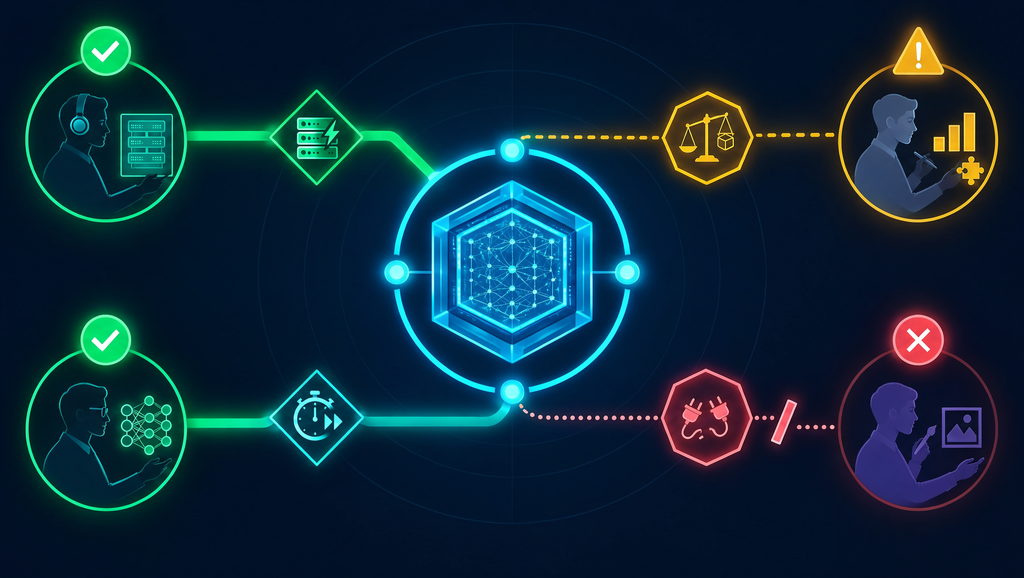
Decision Framework: Who Should Care About DeepInfer?
| Your Role | Should You Care? | Why |
|---|---|---|
| AI/ML engineer or developer | Yes, directly | Study and deploy for DeepSeek model serving |
| Cloud infrastructure provider | Yes, directly | Integrate for hosted AI services |
| CTO or technical decision maker | Yes, strategically | Evaluate for cost reduction in AI workloads |
| Business owner using AI tools | Indirectly | Lower tool costs and better AI services ahead |
| Digital marketing agency | Indirectly | AI-powered marketing tools become cheaper and more capable |
| Non-technical business owner | Awareness only | Understand the trend; benefit through the tools you already use |
How Lorphic Keeps Up With AI Infrastructure Advances
Lorphic is a digital marketing agency based in Guilford, Connecticut that integrates AI advances into client work across SEO, social media marketing, PPC, and content creation. The agency’s $15/hour pricing model means efficiency gains from improved AI tools translate directly into more output per dollar for clients.
Releases like DeepInfer matter to agencies like Lorphic because they reduce the cost of the AI infrastructure powering the tools used daily: content generation, keyword research, analytics summarization, on-page optimization suggestions, and Google Business Profile management workflows. As open-source inference becomes production-grade, the AI tools built on it improve in speed, accuracy, and affordability.
For Connecticut businesses in Stamford, New Haven, Hartford, Bridgeport, Danbury, and Norwalk, this means AI-enhanced marketing at $15/hour continues to deliver more value as the underlying technology advances. Resources are on the blog, with a free consultation and complimentary website report available.
Frequently Asked Questions About DeepInfer
What is DeepInfer?
DeepInfer is DeepSeek’s high-performance inference framework, open-sourced on October 20, 2026 under the Apache 2.0 license. It is the same engine that powers DeepSeek’s production API services. The framework currently supports DeepSeek-V4.1-Flash and runs on NVIDIA SM100 GPUs and Huawei Ascend 950 NPUs. It includes DSpark speculative decoding and integrates FlashMLA, DeepGEMM, and DeepEP kernel libraries.
Why did DeepSeek open-source DeepInfer?
DeepSeek open-sourced its inference engine to build ecosystem support around its technology, apply competitive pressure on proprietary AI providers, and demonstrate engineering capability to the developer community. The repository crossed 10,000 GitHub stars within days of release, indicating strong developer interest in production-grade open-source inference infrastructure.
Can any business use DeepInfer?
Deploying the framework requires significant engineering expertise. It provides offline inference but does not include KV cache management, load balancing, or an online serving layer. It is designed for AI engineering teams, cloud providers, and enterprises with existing AI infrastructure. Non-technical businesses benefit indirectly through cheaper and better AI tools built on this type of open-source infrastructure.
What models does DeepInfer support?
Currently, the framework supports one model: DeepSeek-V4.1-Flash. DeepSeek has indicated that inference code for future model iterations will also be published. The framework is purpose-built for DeepSeek’s Mixture-of-Experts architecture and is not a general-purpose serving solution for other model families.
How does DeepInfer compare to vLLM?
vLLM supports 100+ model architectures and is the most widely used open-source LLM serving framework. DeepInfer supports only DeepSeek models but is optimized specifically for their architecture, delivering superior performance on those models. vLLM is better for teams running diverse model portfolios. DeepInfer is better for teams deploying DeepSeek models at scale.
Curated by Lorphic
Digital intelligence. Clarity. Truth.