

Knowing how to tell if digital marketing is working starts with looking beyond reports full of impressions, reach, clicks, and followers. These metrics show activity, but they do not prove that marketing is generating business. Small businesses investing in SEO, Google Ads, or social media need to know whether that spending produces qualified leads, phone calls, booked appointments, and customers at a sustainable cost. This guide explains which metrics to monitor by channel, where to find the data, and how to identify problems before they waste more of your marketing budget.
Key Takeaways
- Digital marketing performance should be measured by qualified leads, conversions, customers, and revenue, not activity metrics alone.
- Each channel requires different measurements: Search Console data for SEO visibility, conversion tracking for Google Ads, calls and interactions for Google Business Profile, and attributable leads for social media.
- The 30-, 90-, and 180-day checkpoints are useful review points, not guaranteed timelines for results.
- Conversion tracking should be tested before campaigns launch so performance can be measured reliably.
- A sustained decline in qualified leads, organic visibility, or conversion efficiency deserves investigation. One poor month does not automatically indicate a structural problem.
How to Know If Digital Marketing Is Working: Activity vs. Business Metrics
This distinction is where most measurement confusion starts.
Activity metrics measure that something happened in a marketing channel. Page views, social media impressions, email open rates, ad clicks, Google Business Profile views these all confirm that the marketing ran and that someone encountered it.
Business metrics measure that something happened in the business as a result. A phone call from a prospective customer. A form submission that turned into a quote. A booked appointment. A completed purchase. Revenue that can be traced back to a specific channel.
Activity metrics are easy to produce and easy to report. A social media management company can show you steadily increasing impressions every month regardless of whether a single new customer came from social media. A Google Ads agency can show you strong click-through rates while running campaigns that are sending clicks to a page that does not convert.
Business metrics can be harder to measure because they may require conversion tracking, call tracking, and CRM integration. These tools help connect marketing activity to enquiries, qualified leads, customers, and revenue. The level of attribution available depends on how the business collects and connects its data. But they are the only metrics that answer the actual question: is this marketing producing customers?
The test to apply to any marketing report: does this number move the business toward more revenue, or does it only confirm that marketing activity occurred?
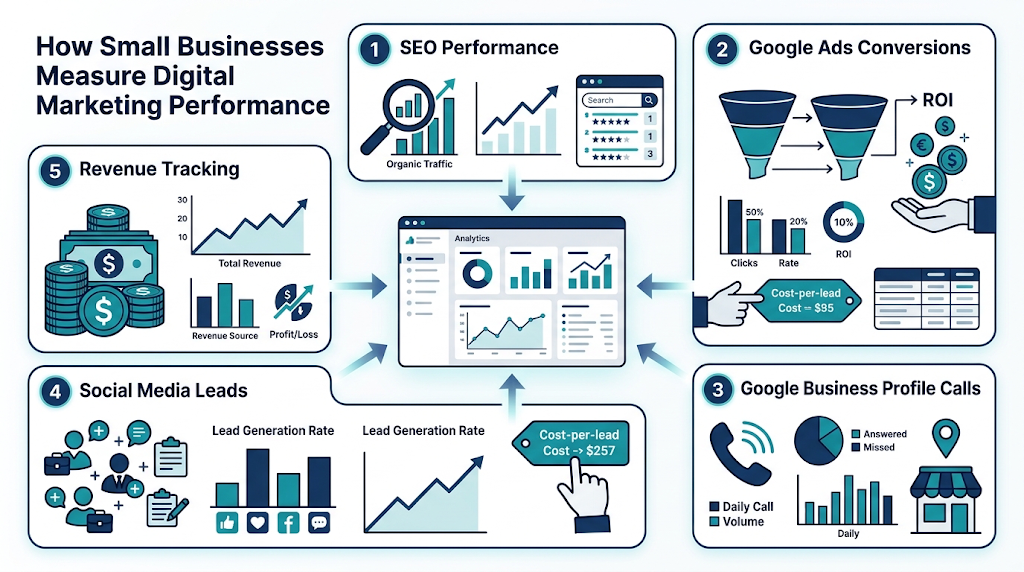
How to Tell If Your SEO Is Working
SEO is a long-term channel. Expecting significant results at 30 days is unrealistic for most competitive categories. If there has been no measurable progress after 90 days, it is reasonable to review the campaign’s strategy and implementation.
What to check and where:
Open Google Search Console it is free and shows the clearest picture of organic search performance available to site owners.
Impressions how many times your website appeared in Google search results. Rising impressions over 60 to 90 days suggest that Google is indexing and surfacing more of the website’s content. Flat or declining impressions after new content has been published is worth investigating.
Clicks how many of those impressions resulted in someone clicking through to the website. Clicks matter more than impressions, but only if the people clicking are prospective customers rather than accidental searchers.
Queries the specific searches that triggered the website to appear. This is the most important data in Search Console for evaluating whether SEO is targeting the right audience. A plumbing company should be appearing for searches like “plumber [town]” and “pipe repair [city]” not for searches that have nothing to do with plumbing services.
Average position where the website ranks on average for those queries. Movement from position 15 to position 8 for a target keyword over three months is meaningful progress, even if it has not yet produced traffic.
What SEO working looks like at 90 days: Rising impressions, queries beginning to appear for target service keywords, and at least some keywords moving into the top 20 positions.
What SEO not working looks like at 90 days: Flat impressions, no new content indexed, no visible movement in keyword positions for any target terms, and the Search Console query list full of branded searches only.
How to Tell If Google Ads Is Working
Google Ads produces faster feedback than SEO often within the first two to four weeks. But “working” means different things depending on whether conversion tracking is in place.
If conversion tracking is not set up: you cannot tell if Google Ads is working. You can see clicks, cost, and impressions. You cannot see whether any of those clicks produced a call or a form submission. Without this baseline, every other metric in the account is decoration.
If conversion tracking is set up: check these in order.
Cost per conversion what it costs in ad spend to produce one trackable customer action (a call, a form submission, a booked appointment). A Connecticut HVAC company with a $5,000 average job value has very different acceptable cost-per-lead economics than a company selling $200 services. The number itself is less important than whether it is trending in the right direction.
Conversion rate what percentage of clicks are converting into contacts.A campaign generating substantial traffic but few conversions may have a landing-page problem, poor traffic quality, a weak offer, or a tracking issue. Compare conversion rates against the campaign’s own history and relevant industry benchmarks before deciding what needs to change. Improving the landing page may produce better results than increasing the budget, depending on traffic quality, the offer, and tracking accuracy.
Search terms report which actual searches triggered the ads. A campaign running on broad match keywords without adequate negative keywords will often appear for searches that have nothing to do with the service. Reviewing the search terms report confirms whether the clicks are coming from genuine prospective customers or from irrelevant searches.
What Google Ads working looks like: Conversions are being recorded accurately, search terms show relevant buying intent, and cost per conversion is sustainable relative to lead quality and customer value. Performance should be assessed using sufficient data rather than expecting costs to decline every month.
Lorphic’s Google Ads management services include conversion tracking setup and monthly reporting that shows cost per lead, not just click activity.
How to Tell If Your Google Business Profile Is Working
The Google Business Profile produces calls and direction requests directly, without the visitor necessarily going to the website first. The performance data is inside the GBP dashboard.
Calls: Review the call-related interactions reported in your Google Business Profile performance data. These indicate engagement with the listing but do not necessarily confirm that a call was completed, that the caller was a qualified prospect, or that a sale resulted. Use call records or call tracking where appropriate to assess actual enquiries.
Direction requests how many people asked for directions to the business from the Maps listing. Relevant for businesses with a physical location. Less relevant for service-area businesses.
Profile views how often the GBP listing appeared in Search and Maps. Rising views suggest improving local pack visibility. Views without corresponding calls may indicate a trust gap: people are seeing the profile but not contacting the business.
Search queries which searches triggered the profile to appear. This reveals whether the GBP is appearing for relevant service searches or predominantly for branded name searches.
What GBP working looks like: Profile views and call volume rising together, triggered by relevant service queries rather than only branded searches.
How to Tell If Social Media Marketing Is Working
This is where the gap between activity metrics and business metrics is largest. Social media is very good at producing impressions, likes, shares, and follower growth and social media reports are very good at leading with these numbers.
The business question is different: is social media producing contacts from prospective customers?
What to actually check:
- Qualified enquiries: Are people asking about your services, requesting quotes, or trying to book through social channels? Separate genuine prospects from spam, existing customers, and unrelated messages.
- Referral traffic: Use GA4 to check whether social visits reach relevant pages and complete meaningful actions.
- Lead attribution: Ask new customers how they found the business and record the answer in your CRM when possible.
For most local service businesses contractors, healthcare practices, professional services social media is a trust reinforcement channel rather than a primary lead generation channel. Someone who found the business through Google may check the Instagram or Facebook page before calling. The social presence confirms that the business is active and professional. The lead came from search.
This does not mean social media has no value. Its contribution is often indirect, so measure it through relevant engagement, referral traffic, and assisted conversions rather than follower counts alone.
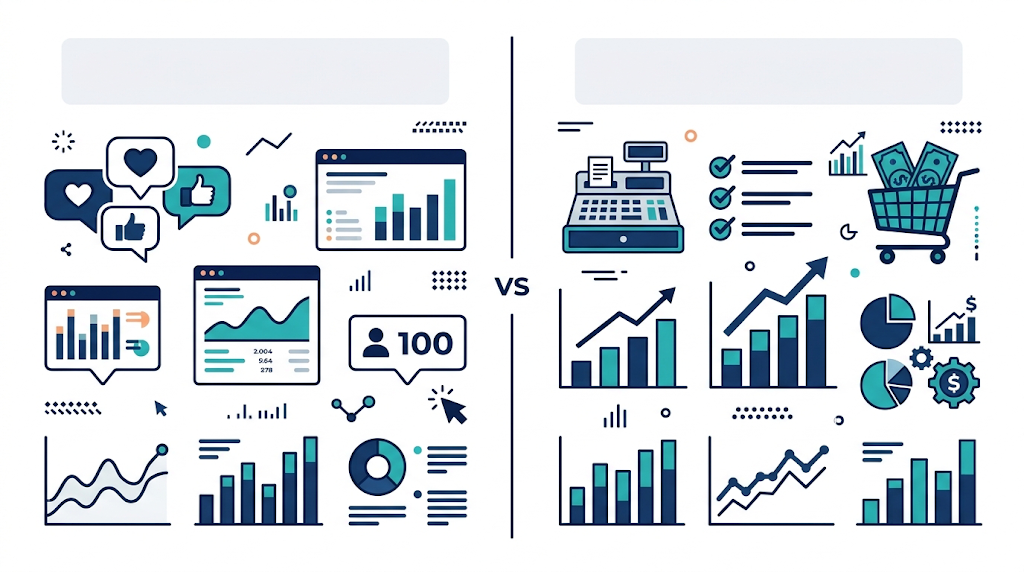
| Channel | Vanity Metric (Don’t Lead With This) | Business Metric (What Actually Matters) |
|---|---|---|
| SEO | Total website sessions | Organic sessions from target service keywords, Search Console position changes |
| Google Ads | Clicks, CTR, impressions | Cost per conversion, conversion rate, search terms quality |
| Google Business Profile | Total views | Calls from listing, direction requests, service query triggers |
| Social media | Followers, likes, reach | DMs from prospective customers, referral traffic to website |
| Email marketing | Open rate | Reply rate, click-throughs to booking page, attributed contacts |
The 90-Day and 180-Day Checkpoints
Marketing channels have different feedback timelines. Evaluating all of them on a 30-day calendar is a mismatch.
30 days: Enough time to confirm that campaigns are technically running, tracking is in place, and the setup is correct. Not enough time for most SEO campaigns to show ranking movement, and often not enough for Google Ads campaigns to exit the learning phase.
90 days: The first meaningful checkpoint. For Google Ads, enough data should exist to identify which keywords are producing conversions and which are draining budget. For SEO, some keyword movement and impression changes should be visible in Search Console. For GBP, a baseline of monthly calls and views is established.
180 days: The point at which the trajectory of each channel becomes clear. SEO that was producing steady ranking improvements at 90 days should be producing measurable organic traffic at 180 days. Google Ads should have moved past the learning phase and be optimising toward qualified conversions. A channel that shows flat or declining performance at 180 days despite consistent, well-structured work is worth reassessing.
What to Do When Digital Marketing Is Underperforming
Identifying that something is not producing results is more useful than continuing to spend on it without feedback.
Check tracking first. Before concluding that a channel is not working, confirm that the tracking is accurate. A Google Ads campaign showing zero conversions may have a tracking installation problem rather than a performance problem. Verify that form submissions and phone calls are being recorded in the conversion data.
Separate the problem. Is the issue traffic quality (the wrong people are arriving), conversion rate (the right people are arriving but not contacting), or channel performance (not enough people are arriving from this channel at all)? Each problem has a different solution.
Set a specific review date. Rather than cancelling immediately or continuing indefinitely, set a date typically one billing cycle by which specific improvement must be visible in the data. Define what “visible improvement” means before the date, not after.
Be honest about what the data shows. A channel that has had six months of consistent, well-structured work and shows no measurable movement in business metrics is not likely to change course with more budget. Redirecting that budget toward channels with better evidence of producing results is a reasonable response to what the data shows.
FAQs
How do you know if digital marketing is working?
Knowing whether digital marketing is working comes down to whether it generates qualified leads through phone calls, form submissions, and appointment bookings at a sustainable cost. Activity metrics confirm marketing ran. Business metrics confirm customers resulted. Only the second category answers the actual question.
What metrics should a small business track for digital marketing?
For SEO: organic sessions from target keywords and Search Console position data. For Google Ads: cost per conversion and conversion rate. For GBP: calls from the listing and queries triggering the profile. For social media: direct messages from prospective customers and referral traffic to the website.
How long does it take to see digital marketing results?
Google Ads can produce leads within the first week once campaigns are approved and tracking is confirmed. SEO typically shows keyword movement within 60 to 90 days and meaningful traffic improvements within six to twelve months. The 90-day mark is the first meaningful checkpoint for evaluating trajectory.
Why does my marketing report look good but nothing is happening?
The report leads with activity metrics—impressions, clicks, and reach—rather than conversion data Ask the provider to show cost per lead, tracked calls and form submissions, and Search Console keyword position data. If conversion tracking is not set up, the data that would answer this question does not exist yet.
What should I do if Google Ads is spending but not producing leads?
Check three things: confirm conversion tracking is correctly installed and recording actions. Review the search terms report to confirm ads are triggering for buying-intent searches rather than irrelevant broad match queries.Evaluate the landing page: a strong ad sending traffic to a weak page can produce high click volume and low conversion rates. produces high click volume and low conversion.
How often should a small business review marketing performance?
Review campaign-level data monthly, including cost per conversion, keyword rankings, and GBP call volume. Quarterly for strategic evaluation assessing whether each channel’s trajectory justifies the continued investment. Immediately whenever conversion volume drops unexpectedly, since tracking breakage looks identical to performance decline.
Conclusion
Knowing how to tell if digital marketing is working means looking beyond activity metrics and evaluating whether your marketing is contributing to meaningful business outcomes. Qualified enquiries, booked appointments, new customers, acquisition costs, and attributable revenue provide a more useful picture than impressions or clicks alone.
Start by verifying tracking, reviewing the metrics relevant to each channel, and comparing performance over time. No single metric tells the whole story, but consistent measurement makes it easier to identify what is working, what needs improvement, and where your budget may be better spent.
For Connecticut businesses that need clearer reporting and a more measurable marketing strategy, explore Lorphic’s local SEO services or current packages.
Curated by Lorphic
Digital intelligence. Clarity. Truth.