

When the United States and China established the U.S.-China Super Intelligence Dialogue during Chinese President Xi Jinping’s September 2026 state visit to Washington, the immediate discussion focused on AI risks, benefits, and communication between the two governments. The White House said the two countries would use the new dialogue to exchange views on those issues and establish a bilateral communication channel for AI incidents, with another exchange planned by November.
For businesses, the broader search-development is important AI is becoming a more prominent interface for finding, comparing, and understanding information online. Google says AI Overviews now reach more than 2.5 billion monthly active users, while AI Mode has surpassed one billion monthly active users. Google also says people are using these AI-powered search experiences to ask longer, more conversational questions.
That creates a practical visibility question for businesses: when a potential customer asks an AI system about a service, product, company, or local provider, does the business appear accurately in the answer?
That is what AI search visibility addresses.
Key Takeaways
A note on AI search: AI-powered search is evolving quickly, and different platforms use different systems to retrieve, rank, summarize, and cite information. The recommendations in this guide focus on improving the clarity, consistency, relevance, and supporting evidence available to those systems rather than promising a particular ranking or citation outcome. different platforms use different systems to retrieve, rank, summarize, and cite information
During Chinese President Xi Jinping’s September 2026 state visit to Washington, the United States and China agreed to establish a U.S.-China Super Intelligence (SI) Dialogue to exchange views on the risks and benefits of AI and to establish a bilateral communication channel for AI incidents. The White House said another dialogue exchange was planned for November.
Trump, speaking at the UN General Assembly days before the summit, told world leaders the United States “leads the world in superintelligence and will continue to do so safely and responsibly.” He signaled little interest in imposing new regulations, saying he would “encourage superintelligence, not rein it in.” OpenAI CEO Sam Altman and other tech leaders including Meta’s Mark Zuckerberg, Nvidia’s Jensen Huang, and Apple’s Tim Cook attended Xi’s state dinner as the Super Intelligence Dialogue framework was finalized.
For businesses, that creates another layer of search visibility to consider. Traditional rankings still matter, but businesses also need to understand how accurately AI-powered systems can identify their services, locations, expertise, and supporting information.

AI systems are already embedded in how people find information. Google’s AI Overviews appear above organic search results for a significant share of commercial queries. ChatGPT, Perplexity, Claude, and Gemini are being used by professionals to research vendors, compare services, and find local providers. When a prospective customer asks an AI system “who are the best accountants in Hartford?”, the businesses included in that answer may enter the customer’s consideration set before the customer visits individual websites.
Three practical reasons this matters right now:
Traditional search is keyword-driven: a user types “plumber Norwalk CT” and gets a list. AI-mediated search is question-driven: a user asks “who’s a reliable plumber in Norwalk that can handle a bathroom renovation on short notice?” and may receive a synthesized answer that names specific businesses and draws on information from multiple sources.
AI-generated answers have specific characteristics that distinguish them from search results:
The business implication: being nominally online is not the same as being AI-visible.A business whose website is vague about what it does, whose GBP information conflicts with its website, and whose name has little supporting third-party information may be harder for AI-powered systems to identify and represent accurately.
AI search visibility is the degree to which a business is accurately represented, cited, and recommended by AI systems when users ask questions relevant to that business’s category, location, or services. It has four components:
Mentions. Does the AI name the business when asked relevant questions? A Danbury dental practice that never appears when someone asks an AI about local dentists has no AI search visibility for that query regardless of its actual quality.
Citations. When the AI mentions the business, does it reference a credible source? Citations can provide users with a way to verify the information supporting an AI-generated answer, not generated from inference.
Recommendations. In competitive queries, does the AI system identify or recommend this business, and does it provide a reason? The reasons given can reflect information available across the business’s website and other sources, although different AI systems use different retrieval and ranking processes.
Accuracy. Does the AI have the right name, address, phone number, services, and hours? Inaccurate AI mentions send prospective customers to wrong numbers or outdated information actively damaging the business.
AI search visibility is not the same as Google rankings. A business can be on page one of Google for its primary keywords and still have poor AI search visibility because traditional search rankings and AI-generated answers can rely on different combinations of relevance, retrieval, content, authority, and other system-specific signals
| Dimension | Traditional SEO | AI Search Visibility |
|---|---|---|
| Primary outcome | Visibility in ranked search results | Inclusion and accurate representation in AI-generated answers |
| Query format | Keywords and natural-language queries | Longer, conversational questions and follow-ups |
| Output | Ranked pages and search features | Synthesized answers with links or citations |
| Business visibility | Ranking position and search features | Mentions, citations, recommendations, or other appearances in answers |
| Important inputs | Relevance, content, links, technical quality and other search signals | Website content, source quality, entity information, relevance, freshness and other system-specific signals |
| Measurement | Search Console, analytics and rank tracking | AI query testing, citation/mention tracking and accuracy checks |
| Relationship | Established search discipline | Complementary layer of an increasingly AI-mediated search environment |
The practical distinction is the outcome being measured. Traditional SEO focuses heavily on visibility within ranked search results, while AI search visibility focuses on whether a business is accurately surfaced and represented within AI-generated answers. The two increasingly overlap rather than operating as completely separate systems.
Different AI-powered search systems use different retrieval, indexing, ranking, and generation processes, so there is no single universal formula for AI visibility. However, businesses can make their information easier to understand by maintaining clear, consistent, and relevant information across the web.
Website content. The foundation. AI-powered search systems may use information from a business’s service descriptions, location pages, specialization pages, team profiles, and other website content
Structured entity information. Business name, address, phone number, category, hours, and service area consistent across the website, Google Business Profile, industry directories, and data aggregators. Inconsistency can create ambiguity and may make it harder for an AI system to determine which information is current or authoritative.
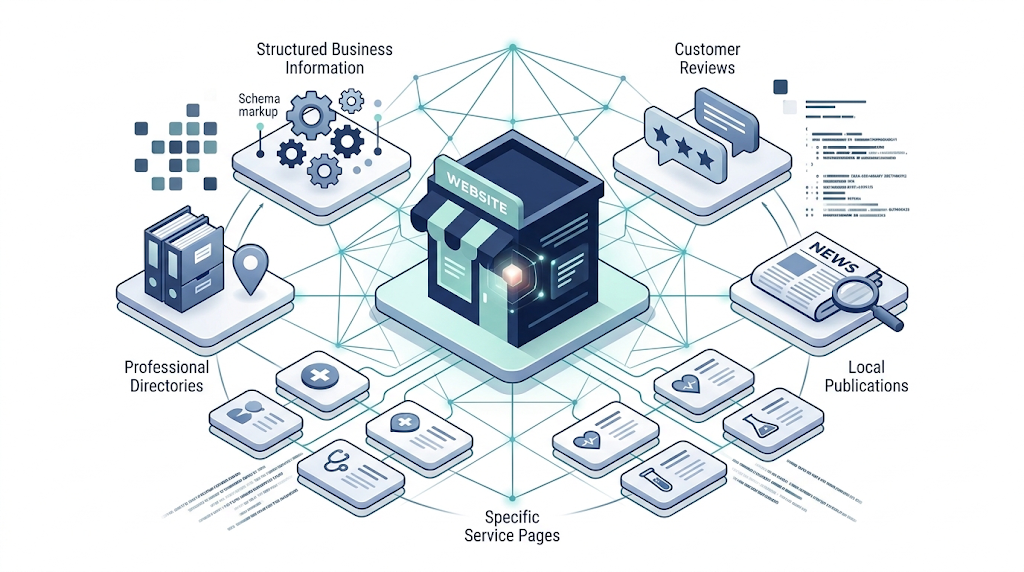
Third-party sources. Reviews, citations in local publications, professional directory listings, association memberships, and credible external mentions can provide additional information about the business’s existence, expertise, location, and reputation For example, a West Hartford firm mentioned by a credible local publication has an additional third-party source supporting its existence and expertise, compared with a business whose information appears only on its own website. Whether and how that source influences an AI-generated answer varies by system.
Content that answers questions. FAQ content addressing real buyer questions in complete sentences is more useful to an AI system than a homepage full of marketing copy. Clear, self-contained answers can make important business information easier for search systems and users to find and interpret, although citation behavior varies by platform and query.
Improving AI search visibility does not require exotic technology. It requires deliberate attention to how a business presents information across the digital landscape.
Clarify exactly what the business does and for whom. “We provide comprehensive marketing solutions” tells an AI very little. “We provide SEO, Google Ads management, and AI search visibility optimization for Connecticut small businesses” tells it exactly who the business serves and how.
Create content that answers real buyer questions. A specific question answered in a clear, self-contained paragraph gives both users and search systems a concise explanation of the business’s expertise.The goal is similar in one respect: make the answer clear, useful, and easy for a search system to interpret.
Ensure business information is consistent everywhere. Same business name, same address, same phone number, same primary category on the website, Google Business Profile, Yelp, LinkedIn, and every industry directory where the business appears. Consistent information reduces the chance that customers and search systems encounter conflicting business details
Earn authoritative third-party citations. Press mentions, professional association listings, review volume on credible platforms, and local directory citations can provide additional evidence about the business’s existence, expertise, location, and reputation. in the business’s legitimacy.
Test actual AI queries regularly. Ask ChatGPT, Gemini, and Perplexity questions a prospective customer would ask in your category. Observe whether your business appears, whether the information is accurate, and where competitors appear instead.
Standard analytics platforms do not provide a complete picture of how often a business is mentioned, cited, or recommended inside AI-generated answers. The approach is different from traditional SEO reporting.
Brand mention tracking. Monitor where the business is named in AI-generated content, AI summaries, and online discussions about AI-recommended providers in the category.
Citation auditing. Periodically check whether AI systems cite the business’s website, GBP, or third-party profiles when generating answers in the category. Which sources do AI systems pull from? Are those sources accurate?
Accuracy testing. Query AI systems directly and evaluate whether the returned business information is current, including the phone number, service area, services, and specializations. Inaccurate AI search visibility sends prospective customers to wrong contacts.
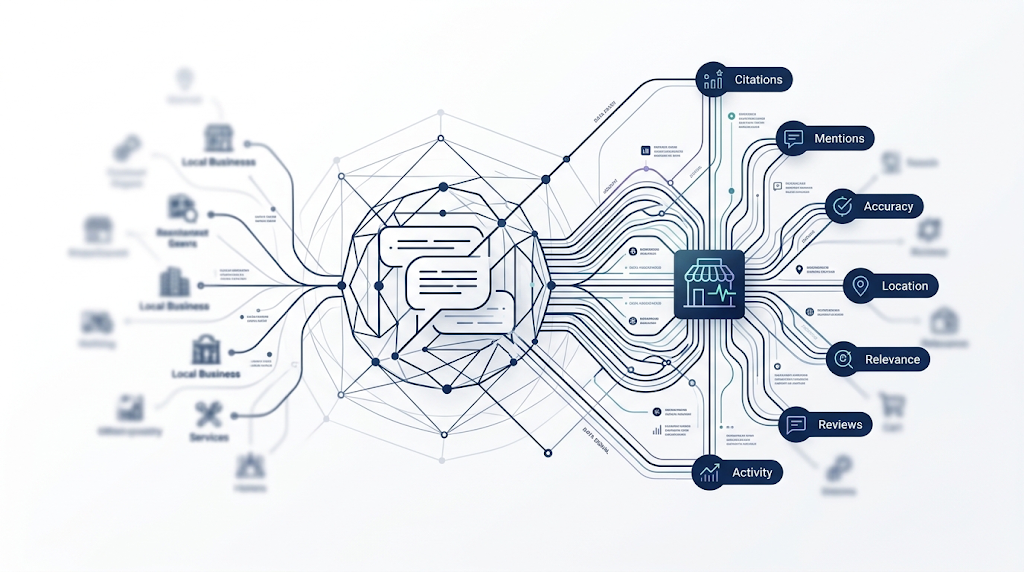
Competitor gap analysis. For queries where a competitor appears and the business does not, analyze what makes their information more complete, consistent, or authoritatively cited. The gap defines the work needed.
Query coverage mapping. Identify the questions prospective customers ask in the business’s category, test AI systems on each, and map where the business appears and where it does not. Coverage gaps become a content and optimization roadmap.
The U.S.-China Super Intelligence Dialogue is a government-to-government framework focused on exchanging views about AI risks and benefits and maintaining communication around AI incidents. It does not establish rules for commercial AI search or determine how AI systems recommend businesses.
Its broader relevance is the growing importance of AI as a technology that governments, companies, and consumers are actively adapting to. That same shift is visible in search. Google says AI Overviews now reach more than 2.5 billion monthly active users and AI Mode has surpassed one billion monthly active users.
For businesses, the practical takeaway is not that traditional SEO has become obsolete. It is that search discovery is expanding into more conversational, AI-mediated experiences. Businesses that clearly communicate their services, locations, expertise, and supporting evidence can be better prepared for that change.
The competitive opportunity is therefore less about predicting exactly how AI search will evolve and more about building a strong information foundation that can support visibility across both traditional and AI-powered search.
Lorphic works with Connecticut businesses on the components of AI search visibility that can be audited, improved, and monitored:
Lorphic’s AEO and AI search visibility services address each of these components for Connecticut businesses. Businesses starting from zero can also explore our guide on AI search optimization services.
AI search visibility is the degree to which a business is accurately mentioned, cited, and recommended by AI systems when users ask questions relevant to that business’s services, location, or category. It is distinct from Google search rankings and requires different optimization approaches.
Traditional SEO optimizes for position in a ranked list of results through keywords, backlinks, and technical signals. AI search visibility optimizes for inclusion in a synthesized AI-generated answer through content clarity, information consistency, and third-party citations. A business can rank well in Google while having poor AI search visibility, or vice versa.
AI citations are references or links within an AI-generated answer that point users toward the sources used to support the response. For businesses, relevant third-party coverage, directory information, reviews, professional profiles, and other credible sources can provide supporting information that AI-powered search systems may encounter. How and whether a particular source is cited depends on the platform and query.
By actively querying AI systems with the questions prospective customers ask, then evaluating whether the business appears, whether the information is accurate, and which competitors appear where the business should. Standard analytics tools do not capture this data.
The U.S.-China Super Intelligence Dialogue is one example of how AI has become an increasingly important subject of government, technology, and business discussion. At the same time, AI-powered search is changing how people ask questions and discover information online. Google reports that AI Overviews now reach more than 2.5 billion monthly active users and AI Mode has surpassed one billion monthly active users.
For businesses, that creates a practical visibility question: when prospective customers use AI to research a service, product, company, or local provider, is the business represented accurately and supported by credible information?
AI search visibility provides a framework for answering that question. It involves clear website content, consistent business and entity information, relevant third-party sources, useful answers to customer questions, and ongoing testing of how AI-powered systems represent the business.
It does not replace traditional SEO. Instead, businesses can treat AI search visibility as a complementary layer of their broader search strategy—one that becomes increasingly relevant as search experiences become more conversational and AI-mediated.
For Connecticut businesses that want to understand how they currently appear in AI-generated answers and where visibility gaps exist, start with Lorphic’s AEO and AI search visibility services.
Curated by Lorphic
Digital intelligence. Clarity. Truth