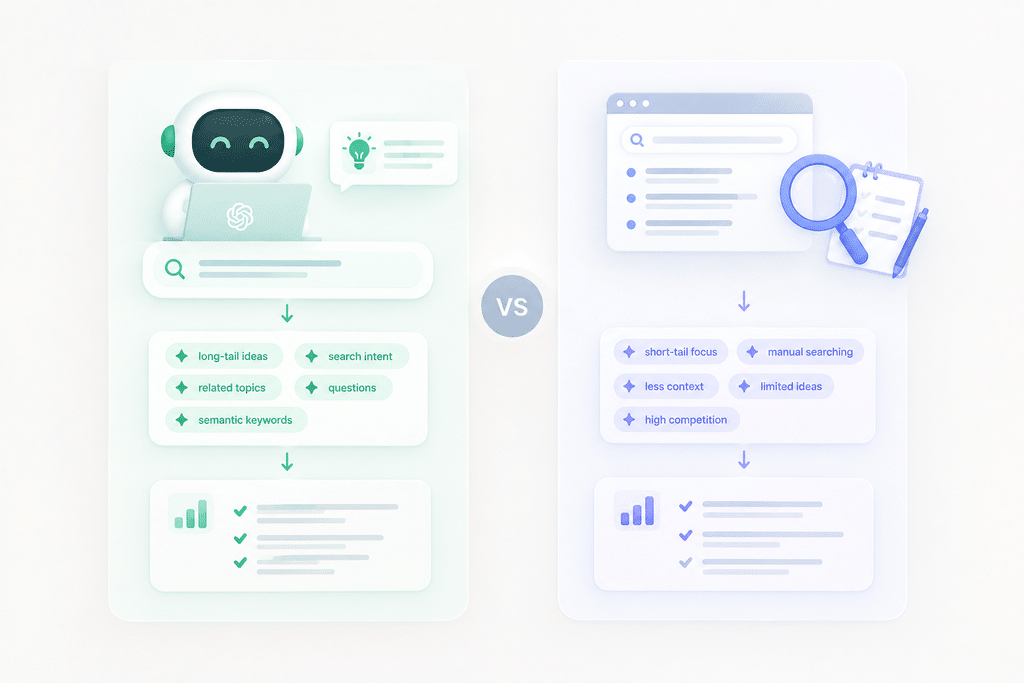
AI keyword research is the practice of identifying what buyers ask AI platforms, ChatGPT, Perplexity, Google AI Overviews, and Gemini, rather than what they type into Google. It is not a replacement for traditional keyword research. It is a second research layer that targets a completely different query format, a different content structure, and a different visibility surface. Most businesses have spent years optimizing for what people type. Almost none have started optimizing for what people ask, and the gap between those two is where the AI visibility opportunity sits in 2026.
Key Takeaways
AI keyword research finds conversational questions; traditional keyword research finds typed search fragments. Both target different surfaces and need different content responses.
AI-powered research surfaces 67% more long-tail opportunities than traditional keyword databases by analyzing conversational search patterns (get-ryze.ai, June 2026)
A 20,000-volume keyword that resolves in an AI Overview may send fewer visitors than a 900-volume keyword that doesn’t, search volume is no longer the only decision metric
The output of ai keyword research is a prompt map, not a keyword list. These are structurally different deliverables requiring different content
Perplexity has identified emerging search patterns up to 3 weeks before they appeared in Ahrefs and Semrush databases
Lorphic runs both research types as an integrated process for Connecticut clients, starting with traditional foundations before layering the AI prompt map
What Is the Actual Difference Between AI Keyword Research and Traditional Keyword Research?
Traditional keyword research mines historical search data to find what people have typed into Google. It produces a ranked list of keywords with volume, difficulty, and CPC. AI keyword research identifies what people are asking AI platforms right now, in full conversational sentences.
The output is a prompt map: a structured collection of complete questions, follow-up queries, and intent patterns that buyers use when they interact with ChatGPT, Perplexity, or Google AI Overviews. A page optimized perfectly for “HVAC company Hartford CT” may never appear in a ChatGPT answer about HVAC companies in Hartford, because the conversational question triggering that AI answer is structurally different from the typed keyword.
Get-ryze.ai’s June 2026 testing across ecommerce sites found that AI-powered research surfaces 67% more long-tail opportunities than traditional databases, specifically because conversational queries are rarely fully captured in Ahrefs or Semrush. These long-tail questions are also the queries most likely to trigger AI Overviews, which means ignoring them concentrates your content on the surface with declining click rates rather than the surface with growing engagement.
Dimension
Traditional Keyword Research
AI Keyword Research
Data source
Historical search database
Real-time AI platform queries
Query format
Fragmented (2-5 words)
Conversational (8-20 words)
Primary metric
Search volume + keyword difficulty
Citation frequency potential + intent completeness
Tool
Ahrefs, Semrush, Google Keyword Planner
ChatGPT, Perplexity, Claude, SE Ranking AI
Content target
Top 10 Google rankings
AI-generated cited answer
Competition view
Who ranks for this keyword
Who gets cited when AI answers this question
Data lag
Weeks to months behind real behavior
Real-time trend detection
The Same Topic Researched Two Ways: A Real Connecticut Example
The clearest way to understand ai keyword research is to run the same topic through both methods and compare the outputs. The topic: finding an HVAC company in Connecticut.
Traditional keyword research output (Ahrefs/Semrush):
Keyword
Volume
KD
Search Type
hvac companies connecticut
480/mo
Low
Navigational
hvac contractors ct
320/mo
Low
Commercial
air conditioning installation hartford
260/mo
Low
Commercial
best hvac company new haven
200/mo
Low
Commercial
hvac repair stamford ct
150/mo
Very low
Transactional
AI keyword research output (prompt mapping via ChatGPT + Perplexity):
Prompt Discovered
Platform Where Found
Content Needed
“Which HVAC company in Connecticut has the best reviews for first-time AC installation?”
Perplexity
Review-backed answer with specific brand mentions
“What is the average cost to install central air in a Connecticut colonial home in 2026?”
ChatGPT
Cost guide with CT-specific figures and attribution
“How do I find a licensed HVAC contractor in New Haven for weekend emergency repairs?”
Google AI Overviews
Licensing info + local resource with contact details
“Is it better to repair or replace an older HVAC system in Connecticut winters?”
Perplexity
Decision guide with cost comparison data
“What questions should I ask an HVAC contractor before hiring them in Hartford?”
ChatGPT
Checklist format with CT licensing specifics
The traditional list tells you what to rank for. The AI list tells you what to be cited for. A single blog post can capture both, but only if the research was done for both surfaces. Doing only the traditional research means the conversational queries go unanswered by your content, and AI platforms cite competitors who did answer them.
The 7 Differences Between AI Keyword Research and Traditional Keyword Research
These are not minor variations in process. Each difference changes what content you produce, how you structure it, and how you measure whether it worked.
1. Query format is fundamentally different. Traditional keywords are fragments: “HVAC contractor Hartford.” AI prompts are complete sentences with context: “What questions should I ask before hiring an HVAC contractor in Hartford?” The same intent produces two structurally different queries. Content optimized for the fragment rarely answers the complete question the way an AI system needs it answered.
2. Volume is not the right primary metric for AI research. A critical insight from SEOmator’s July 2026 analysis: “A 20,000-volume term that resolves in an AI Overview may send fewer visitors than a 900-volume term that doesn’t.” AI keyword research uses citation frequency potential as its primary metric because ranking without being cited in the AI answer above the results increasingly produces impressions with no clicks.
3. The research tool is completely different. Traditional ai keyword research uses Ahrefs, Semrush, or Google Keyword Planner. AI keyword research requires direct platform testing. You run your seed topics as full questions in ChatGPT, Perplexity, and Google AI Overviews and document what answers are generated, what sources are cited, and what follow-up questions the platforms surface. There is no single tool that fully replicates this process yet in 2026.
4. AI research detects trends traditional databases miss. Perplexity’s real-time indexing identified emerging search patterns around “AI shopping assistants” three weeks before that topic appeared in Ahrefs or Semrush databases. For businesses in fast-moving categories, digital marketing, healthcare adjacent, financial services, this lag matters. AI keyword research is the only research method that finds queries that buyers are asking right now rather than what they were asking last quarter.
5. The content structure target is different. Traditional keyword research targets a page structure that helps Google rank your content in the top 10. AI keyword research targets a content structure that helps AI systems extract and cite your content. The answer must appear in the first two sentences. Headings must be questions. Every paragraph must be self-contained. These structural requirements are not optional for AI citation, they are the mechanism.
6. Competition analysis works differently. For traditional research, you analyze the top 10 ranking pages to understand what you need to create to compete. For ai keyword research, you analyze which pages AI platforms cite when answering the target question, and those are often not the top-10 ranking pages. Cited.com’s 2026 analysis found that 56% of AI citations come from sources outside the top 10 Google results. Your citation competition is not identical to your ranking competition.
7. The measurement output is different. Traditional keyword research success is measured in rankings and organic traffic. AI keyword research success is measured in citation frequency: how often and in what position your content or brand name appears when AI platforms answer the target questions. These are separate metrics that require separate tracking infrastructure. Combining them into one “SEO report” produces a misleading picture of performance on both surfaces.
How to Do AI Keyword Research: A Practical Process
The process requires discipline most keyword research workflows currently lack.
Step 1, Start with your traditional keyword list. Run your target service category through Ahrefs or Semrush and pull the top 20 to 30 keywords. This is your traditional foundation and it is still necessary. Google’s AI optimization documentation confirms that AI Overviews rely on core Search ranking signals, meaning traditional SEO authority is the prerequisite for AI citation eligibility.
Step 2, Convert keywords to conversational questions. Take each keyword and expand it into two or three complete questions representing the different intents behind that fragment. “HVAC contractor Hartford” becomes: “Who is the most reliable HVAC contractor in Hartford for emergency repairs?”, “What should I expect to pay an HVAC contractor in Hartford?”, “How do I check if an HVAC contractor is licensed in Connecticut?”
Step 3, Run each question in ChatGPT, Perplexity, and Google AI Overviews. Document three things: which sources are cited in the answer, how the answer is structured, and what follow-up questions the platform surfaces automatically.
Step 4, Build a prompt map. Organize the discovered questions by intent type (informational, commercial, comparison, local) and identify which ones have no strong content on your site answering them directly. These gaps are your content priorities.
Step 5, Map each prompt to a content type. Some prompts require a dedicated FAQ block on a service page. Some require a standalone blog post. Some require an update to an existing page’s opening paragraph. The prompt map tells you which content fix serves which prompt.
Step 6, Validate with citation monitoring. After publishing or updating content, re-run the same prompts monthly and track whether your content now appears in the AI answer, and whether it moved from absent to cited or from lower citation to higher.
How Lorphic Applies AI Keyword Research for Connecticut Small Businesses
Most Connecticut businesses have keyword lists built entirely from Ahrefs or Semrush, with no ai keyword research layer on top. The prompt map for most service categories in New Haven, Hartford, Stamford, and Bridgeport is unclaimed because no local competitor has run this research yet.
Lorphic’s process integrates both research types. It starts with a traditional keyword cluster built from Ahrefs data, then runs a Connecticut-specific AI visibility audit that maps the actual prompts buyers are using across AI platforms for that service category in Connecticut. The gap between what the keyword list covers and what the prompt map reveals is almost always significant.
For a Stamford professional services firm, the keyword list might show “attorney Stamford CT” and “business lawyer Connecticut” with solid volume. The prompt map reveals that buyers are asking Perplexity: “What type of lawyer do I need for a commercial lease dispute in Connecticut?”, a complete, specific question that current content on most CT law firm sites does not directly answer. That one unanswered prompt represents an open citation opportunity.
The AI SEO agency overview covers the full framework for Connecticut businesses evaluating this type of integrated research. For businesses ready to run both layers, the AI visibility audit is the starting point. Our AEO services for Connecticut explains how citation building connects to prompt research for local service categories.
Decision Framework: Do You Need AI Keyword Research, Traditional, or Both?
Your Situation
What You Need
First Action
New site, no rankings, no traffic
Traditional first, AI citation requires search authority
Standard keyword research and content foundation
Ranking well but no AI Overview appearances
Add AI keyword research layer immediately
Run top 10 keywords as prompts in ChatGPT and Perplexity
Traffic dropping without ranking changes
AI Overviews pulling clicks from ranked pages
Check AI Overview impression share in Search Console
Competitors appearing in AI answers, you are not
AI keyword research to find prompt gaps
Build prompt map for top 5 service categories
Publishing content but no citations
Content structure problem, not research problem
Audit existing content for answer-first structure
If you have been doing traditional keyword research for more than 12 months without adding a prompt research layer, your content covers only half the surfaces buyers currently use. Traditional keyword research remains essential. The ai keyword research layer covers the other half.
6 Frequently Asked Questions About AI Keyword Research
What is ai keyword research and how is it different from traditional keyword research?
AI keyword research identifies what buyers ask AI platforms like ChatGPT, Perplexity, and Google AI Overviews in full conversational sentences. Traditional keyword research finds what people type into Google in fragmented 2 to 5 word phrases. Both target different query formats, different content structures, and different visibility surfaces. Neither replaces the other.
What tools do you use for ai keyword research?
Direct platform testing in ChatGPT, Perplexity, Claude, and Google AI Overviews is the core method. Supporting tools include SE Ranking’s AI Keyword Research module, Otterly for citation monitoring, and Frase for content brief generation. Traditional tools like Ahrefs and Semrush still provide the volume and difficulty validation layer; AI tools add the conversational intent layer on top.
How long does keyword research take when using AI tools?
Traditional keyword research for one service category takes 2 to 4 hours manually. AI keyword research adds 1 to 2 hours per category for prompt mapping and platform testing. Subsequent cycles are faster as the prompt set gets refined from previous months of citation data.
Does ai keyword research replace traditional keyword research entirely?
No. Google’s AI Overviews and AI Mode rely on core Search quality signals, which means traditional SEO ranking authority is the prerequisite for AI citation eligibility. A site with no rankings is unlikely to earn AI citations regardless of how well its content answers conversational prompts. The correct approach is traditional keyword research as the foundation with AI keyword research as the second layer.
How do I know if an ai keyword research process is working?
Run the same 30 to 50 test prompts across ChatGPT, Perplexity, and AI Overviews monthly and track whether your pages begin appearing in the answers. Citation frequency is the metric. If it is not tracked separately from rankings, the process has no measurement output.
Can small Connecticut businesses benefit from ai keyword research?
Yes, and more immediately than larger competitors in many cases. AI systems do not automatically favor large brands for location-specific questions. A Guilford or Westport service business that directly answers the conversational questions buyers ask about its service category in Connecticut is competitive for AI citations on those local prompts. The prompt map for most CT service categories is currently unclaimed by any local business.
AI keyword research does not obsolete five years of Ahrefs work. It extends it. Your existing keyword list covers what Google users type. Your prompt map covers what AI users ask, and running both together is what full-spectrum content strategy looks like in 2026.
Curated byLorphic Digital intelligence. Clarity. Truth