
An AEO agency does not simply rewrite your homepage with different keywords. For Connecticut businesses, AEO services (Answer Engine Optimization) involve a structured set of activities designed to improve how AI-powered systems, including ChatGPT, Perplexity, Google AI Overviews, and Gemini, find, interpret, and cite your content when answering real buyer questions. This post explains each of those activities in plain terms.
Key Takeaways:
- AEO services are not a single tactic. They cover AI visibility audits, prompt research, citation analysis, content restructuring, schema markup, entity consistency, technical fixes, and ongoing monitoring.
- An AI visibility audit is the starting point. It maps where your business currently appears (and does not appear) across ChatGPT, Perplexity, Gemini, and Google AI Overviews before any optimization work begins.
- Prompt research is different from keyword research. Buyers ask AI systems full questions in natural language, and your content needs to be structured around those question patterns, not just traditional search keywords.
- Entity consistency matters for local Connecticut businesses. If your business name, address, and service area are described differently across directories, Google Business Profile, and your own site, AI systems have less confidence recommending you.
- No AEO agency can guarantee AI citations. Citation selection is controlled by the platforms. Credible providers improve the right signals and measure visibility changes transparently.
- AEO extends your existing SEO investment. It does not replace it. Content that performs well in organic search and content built for AI citation overlap significantly in what good looks like.
What an AI Visibility Audit Covers
The first step in any serious AEO engagement is an AI visibility audit. This is distinct from a standard SEO audit. Where a traditional audit focuses on rankings and backlinks, an AI visibility audit maps where your business currently appears across the major answer engines, and where it does not.
A typical audit involves defining a prompt set: 30 to 50 questions that a prospective customer would realistically ask an AI platform in your category. For a Bridgeport personal injury firm, those prompts might include questions about local attorneys, contingency fees, and case timelines. For a Stamford financial advisory practice, they might cover retirement planning, fiduciary standards, and fee structures. Each prompt is run across ChatGPT, Perplexity, Gemini, and Google AI Overviews separately, because citation behavior differs meaningfully between platforms.
The audit documents which sources are cited, whether your business appears, and if so, how it is characterized. That baseline is what makes subsequent work measurable.
Prompt and Query Research
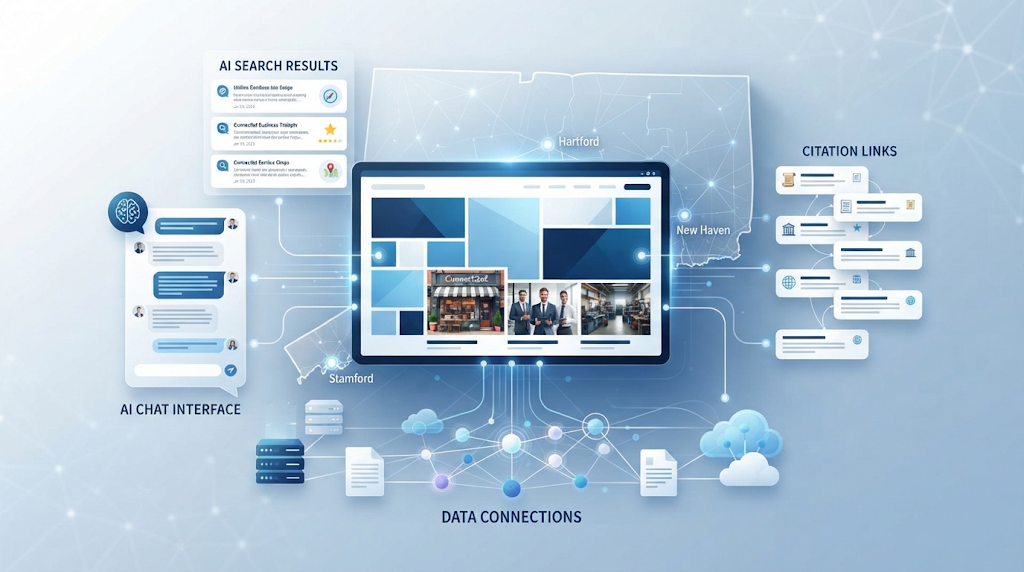
Prompt research is the AEO equivalent of keyword research, but the intent model is different. People do not ask AI systems short fragmented queries the way they type into Google. They ask full questions, describe specific situations, and request comparisons or recommendations.
For a Hartford-based medical practice, the relevant AI prompts may look nothing like the keywords in their existing content strategy. Someone asking Perplexity “what should I know before seeing a cardiologist in Hartford” expects a different kind of answer than someone typing “Hartford cardiologist” into Google.
Effective prompt research identifies the actual question patterns in your category, prioritizes them by how frequently they appear to trigger AI-generated answers, and maps them against your current content coverage to identify gaps. My Web Audit’s prompt strategy guide outlines a practical framework for building and prioritizing that prompt set.
Citation Analysis: Who Is Getting Cited and Why
Citation analysis examines the specific sources that AI platforms select when answering prompts in your category. This is not the same as a backlink audit. The sources that appear in AI citations include editorial websites, industry associations, review platforms, local press, and government resources. Your competitors’ content may or may not appear.
The analysis surfaces patterns: does your category favor long-form educational content or concise direct answers? Do AI systems pull from local sources or national ones? Are the citations dominated by a single platform type, or distributed?
For a New Haven-area law firm, citation analysis might reveal that Perplexity consistently cites state bar resources and local news articles when answering legal questions, while ChatGPT leans on general legal education sites. That distinction directly informs where content efforts and third-party presence-building should focus.
Content Optimization for AI Extractability
Once the audit and research phases establish what is missing and what is being cited, the content work begins. This is the largest component of most AEO engagements.
AI systems extract answers from content that is structured to make extraction easy. The specific changes this involves include:
- Leading each section with a direct answer, not a preamble
- Using question-based headings that mirror how buyers phrase queries
- Writing in complete, self-contained paragraphs that can be lifted as standalone answers
- Adding FAQ sections with full, specific answers rather than vague summaries
- Removing hedged, filler, or promotional language that reduces citation-worthiness
Content optimization is not the same as content creation. In many cases, existing pages can be restructured to perform significantly better. New content is added where genuine topic gaps exist, not to inflate volume. A full AEO checklist can help you assess how much of this work your current site still needs.
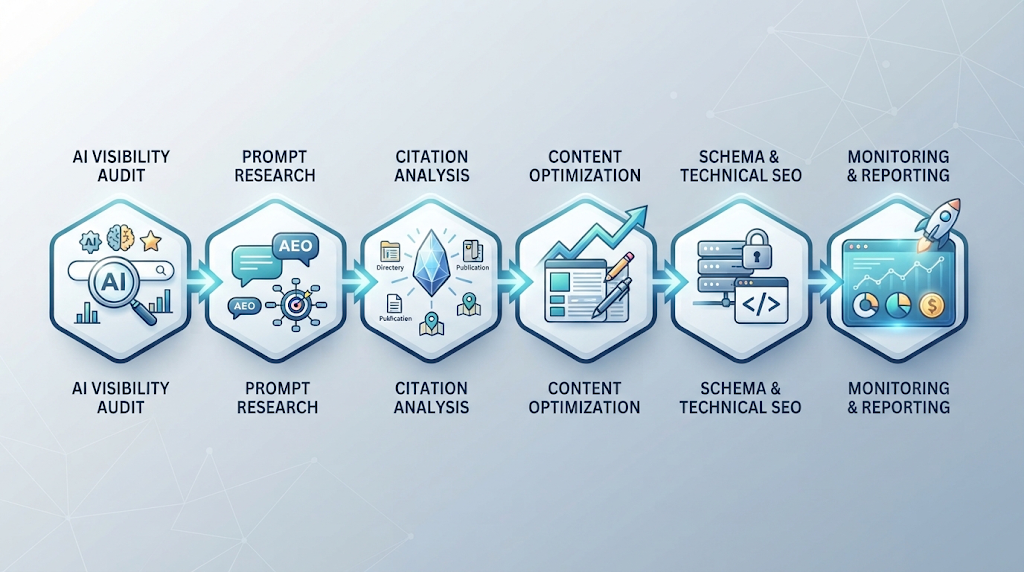
Structured Data and Schema Implementation
Schema markup is the technical layer that helps AI systems parse your content accurately. For AEO purposes, the most relevant schema types include Article, FAQPage, LocalBusiness, HowTo, and MedicalOrganization depending on the category.
Schema does not cause AI citations on its own. Thin or poorly structured content with accurate schema will still be passed over. But content that is both substantive and properly marked up is consistently better positioned for extraction, particularly in Google AI Overviews, which draw from Google’s existing index and therefore benefit from the same signals that support traditional search performance.
For local Connecticut businesses, LocalBusiness schema is particularly important. It communicates service area, hours, contact information, and category to AI systems in a standardized format that reduces ambiguity about who you are and where you operate.
Entity Consistency and Local Optimization
AI systems resolve information to named entities. When an AI platform is deciding whether to cite a business, it draws on signals from across the web, including Google Business Profile, major directories, industry listings, and local press. If those sources disagree on basic information (your business name, address, phone number, or service area), the AI system has less confidence in recommending you.
Entity consistency work involves auditing every major listing where your business appears, correcting discrepancies, and ensuring that the description of what you do and where you do it is accurate and uniform. According to LSEO’s 2026 analysis, AI search tools synthesize information from multiple sources, and if those sources disagree, a business may be excluded from AI summaries even when it is a strong match for the query in practice.
For businesses serving specific Connecticut markets, this localization work matters in practical terms. A landscaping company operating across Fairfield County needs its service area described consistently enough that AI platforms can recommend it for location-specific queries in Westport, Darien, or Stamford, not just for the business name alone.
Technical Improvements That Support AI Visibility
AEO services are not purely content-focused. Several technical factors affect whether AI systems can retrieve and trust your content at all.
Clean crawlability is a baseline requirement. AI systems cannot cite pages they cannot access. This means checking robots.txt configuration, ensuring key content pages are not inadvertently blocked, and verifying that site architecture does not bury important pages behind excessive navigation layers.
Page load speed and Core Web Vitals remain relevant signals, particularly for Google AI Overviews, which rely on Google’s existing crawl and index infrastructure. Content freshness also matters: research from AirOps found that more than 70% of pages cited by AI systems were updated within the preceding 12 months, which makes visible update timestamps and periodic content refreshes a practical part of ongoing AEO maintenance.
Monitoring, Reporting, and Ongoing Measurement
AI visibility is not a static achievement. Citation patterns shift as platforms update their retrieval models, as competitors improve their content, and as new AI surfaces emerge. Research from AirOps indicates that only about 30% of brands remain visible from one AI query run to the next, which means ongoing monitoring is a structural requirement rather than a premium add-on.
Monitoring in a well-run AEO program includes regular prompt testing across platforms, tracking of referral traffic from AI sources in Google Analytics 4 (ChatGPT has appended utm_source=chatgpt.com to citation links since June 2025, making attribution more direct), and quarterly reviews of citation share relative to competitors.
Reporting should connect AI visibility changes to business metrics where attribution is possible, while being honest about attribution limits. Some AI-influenced research does not end with a traceable click. A buyer who sees your Hartford accounting firm recommended in a Perplexity summary may search for you directly hours later. That conversion is real; it is simply harder to assign to a specific source in GA4.
No AEO provider can guarantee that your business will appear in any specific AI response. Citation selection is controlled by the platforms, not by the agency. Credible providers report on measurable visibility signals and document their methodology clearly.
The Relationship Between AEO and Your Existing SEO
AEO services do not replace traditional SEO. If you are newer to the discipline, what AEO is in digital marketing is a useful place to start. Strong organic rankings, domain authority, and technical SEO health all remain foundational, particularly for Google AI Overviews, which still draw heavily from Google’s indexed content. The work overlaps in meaningful ways: content that is well-structured, specific, and authoritative tends to perform better in both organic search and AI citation.
The meaningful addition that AEO services bring is a measurement and optimization layer specifically designed for AI platforms, one that treats citation as a distinct goal from ranking, and that monitors performance across ChatGPT, Perplexity, and Gemini in addition to Google.
For Connecticut businesses already investing in SEO, AEO work is typically additive. It extends the reach of existing content strategy rather than replacing it.
| Layer | Primary Goal | Main Signals |
|---|---|---|
| SEO | Organic rankings | Backlinks, on-page optimization, authority |
| AEO | AI citations | Content structure, schema, entity clarity, extractability |
| GEO | Broad generative AI presence | Brand mentions, third-party corroboration, model training signals |
Frequently Asked Questions
What is the difference between an AI visibility audit and a regular SEO audit?
An SEO audit evaluates whether your pages can rank in traditional search results, focusing on keyword targets, backlinks, and technical performance. An AI visibility audit maps where your business currently appears across AI answer engines such as ChatGPT, Perplexity, and Google AI Overviews, and identifies which prompts in your category you are missing from. The two audits use different methodologies and measure different outcomes.
Can an AEO agency guarantee that my business will appear in AI answers?
No. AI citation selection is controlled by the platforms themselves and their retrieval systems are not fully transparent. A legitimate AEO agency can improve the signals that make citation more likely (content structure, schema, entity consistency, topical coverage) and measure changes in AI visibility over time, but cannot promise that specific prompts will surface your business.
How long does it take to see results from AEO services?
Technical improvements such as schema implementation and crawlability fixes can register relatively quickly. Meaningful improvement in citation frequency across platforms typically develops over three to six months of consistent work, with entity and corroboration improvements taking longer. Ongoing monitoring is necessary because citation patterns change as AI platforms update their models.
Do AEO services apply to small local businesses, or only large brands?
Local and regional businesses can earn AI citations, particularly for location-specific queries where national brands are not directly competing. A New Haven accounting firm or a Hartford home services company operating in a defined geographic market faces a regional competitive set in AI citations rather than a national one. Credible providers will be transparent about which query categories are realistically winnable for a business of your size and authority.
How do you measure whether AEO services are working?
The most direct measures are citation frequency across target prompts, referral traffic from AI platforms tracked in GA4, and competitive share of AI citations in your category. Prompt testing across ChatGPT, Perplexity, Gemini, and Google AI Overviews at defined intervals provides a repeatable baseline. Attribution of downstream business impact (leads, calls, revenue) remains partially limited because AI-influenced research does not always result in a direct traceable click.
What should a Connecticut business ask before hiring an AEO agency?
Ask how they define and measure AI visibility, what their prompt research methodology looks like, which platforms they monitor, how they report on citation changes, and how they handle the attribution gap between AI-influenced research and direct traffic. Avoid agencies that cannot explain their measurement approach in specific terms or that guarantee citation frequency.
Working With Lorphic on AEO
Lorphic works with Connecticut businesses across professional services, B2B, and local service categories to assess and improve AI citation positioning. If you want to understand where your business currently stands in AI search before committing to a program, an AI visibility audit is the right starting point.
If you want to go deeper on any of the activities covered here, the AEO Services for Connecticut Businesses pillar page covers who needs this work, what it costs, and what realistic outcomes look like.
Curated by Lorphic
Digital intelligence. Clarity. Truth