
The most important thing to know about Gemini 4 Argon pricing is that its introductory price is not the long-term rate.
Google says Argon launches at $2 per million input tokens and $10 per million output tokens. After the introductory period, those rates increase to $4 and $20 respectively. Google has not published how long the introductory period will last. If you’re building anything expected to outlive a short pilot, budget for the post-introductory rate from the start.
The second most important thing: Google has not published a public API model ID or a general-access signup, and Argon is not yet broadly accessible. This post covers what the pricing structure looks like, who has access now, and how to prepare for when broader access arrives.
Gemini 4 Argon Pricing: The Full Structure
Per Google’s official announcement, Argon launches with a two-phase pricing structure.
| Token type | Introductory rate | Standard rate (post-introductory) |
|---|---|---|
| Input tokens | $2.00 per million | $4.00 per million |
| Output tokens | $10.00 per million | $20.00 per million |
| Cached input | 95% off input rate | 95% off input rate (same discount) |
At the introductory rate, cached input costs $0.10 per million tokens. At the standard rate, $0.20 per million.
What Google hasn’t published:
- How long the introductory period lasts
- Whether reasoning tokens bill at the output rate (relevant for long thinking traces)
- Per-task cost data for any evaluated workflow
That last gap matters. As DataCamp’s coverage noted: a model’s per-token price and its per-task cost are two different numbers. A cheaper token rate can still produce a more expensive invoice if the task requires more tokens to complete. Google has not released the kind of per-task cost data that would let you estimate Argon’s real-world cost before you can run it yourself.
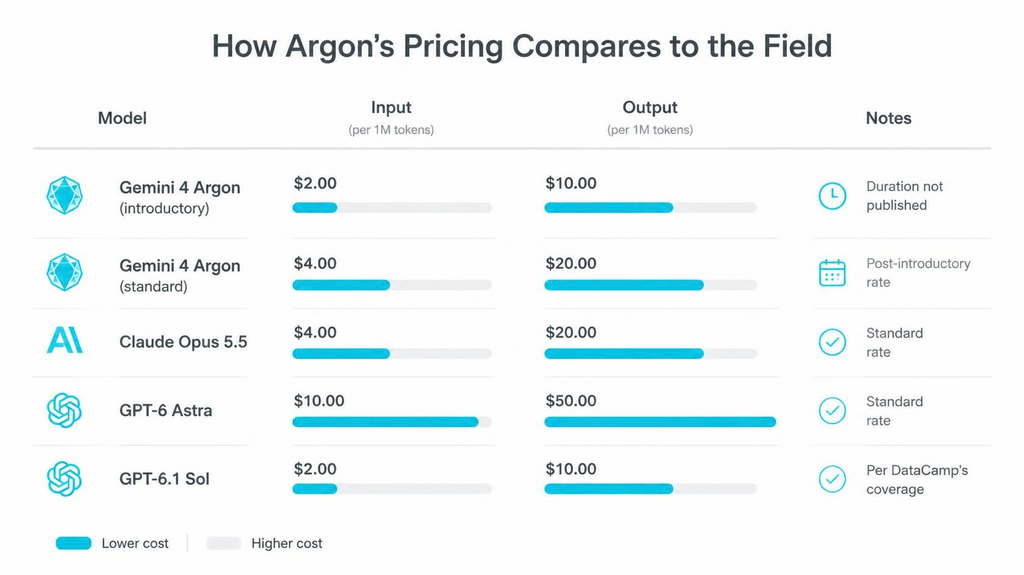
How Argon’s Pricing Compares to the Field
The introductory rate makes Argon one of the cheaper frontier-class options on the market. The standard rate puts it in a different position.
| Model | Input (per 1M tokens) | Output (per 1M tokens) | Notes |
|---|---|---|---|
| Gemini 4 Argon (introductory) | $2.00 | $10.00 | Duration not published |
| Gemini 4 Argon (standard) | $4.00 | $20.00 | Post-introductory rate |
| Claude Opus 5.5 | $4.00 | $20.00 | Standard rate |
| GPT-6 Astra | $10.00 | $50.00 | Standard rate |
| GPT-6.1 Sol | $2.00 | $10.00 | Per DataCamp’s coverage |
Competitor pricing reflects the rates reported in DataCamp’s September 2026 coverage and may change independently of Gemini 4 Argon’s pricing.
At the introductory rate, Argon’s $2/$10 token pricing matches GPT-6.1 Sol’s reported rate and is one-fifth of GPT-6 Astra’s reported $10/$50 rate. At the post-introductory rate, Argon’s $4/$20 pricing matches the rate DataCamp reports for Claude Opus 5.5.
The benchmark results point to different strengths at that matched price point: Argon’s published scores are higher on long-context and knowledge-work evaluations, while Opus 5.5 scores higher than Argon on Terminal-Bench 4.0 and FrontierSWE v2. That makes workload-specific testing more useful than comparing token prices alone.
The Output Token Math: Where 1M Tokens Gets Expensive
One of Argon’s most notable technical changes is its 1M-token output limit, which Google describes as industry-leading. It’s also where the cost math needs careful attention.
At the standard output rate of $20 per million tokens, generating 1M tokens of output in a single trajectory costs $20. One call. Whether that’s expensive depends entirely on what you would otherwise spend to accomplish the same task through multiple prompted sessions with context re-sending costs at each step.
The scenarios where 1M output is valuable: large codebase migrations or rewrites that would otherwise require chaining multiple sessions, complex research synthesis across many documents, long-horizon agentic tasks where context state loss between sessions is the primary failure mode.
The scenarios where 1M output creates billing surprises: models running extended reasoning traces that you’re not accounting for, long autonomous sessions that weren’t expected to generate at that scale, or per-step costs in agentic workflows where each step re-sends a growing input context.
Google has not yet clarified how reasoning tokens will be billed. If reasoning tokens are billed at the output rate, long reasoning traces could materially increase costs on complex tasks. This is a material open question for anyone building an agent on Argon.
The Cache Discount: Where It Matters Most
Cached input at 95% off is the pricing feature that matters most for agentic and coding workloads. At the standard rate, that brings cached input to $0.20 per million tokens.
In multi-turn agent sessions, the majority of input tokens are re-sent context: the system prompt, conversation history, tool definitions, and previously read files. If the session maintains a warm cache, most of those tokens bill at the cached rate rather than the full input rate.
For example, if 90% of input tokens in a session qualified for cached pricing at the standard rate, the blended input cost would be about $0.58 per million tokens (90% of $0.20 + 10% of $4.00). Actual savings depend on how much of a workload qualifies as cached input.
The important caveat is that the 95% discount applies specifically to cached input tokens. Google has not yet published enough implementation detail to estimate cache hit rates for a typical Argon workflow, so the actual savings will depend on workload characteristics.
Gemini 4 Argon API Access: Where Things Stand
As of September 30, 2026, Argon is not publicly accessible through any API endpoint.
Current access: Limited to trusted cyber defenders in the Fairwind Program and Google’s internal teams.
Who gets access next, per Google’s announcement: Paid API customers and Google AI Ultra subscribers, in that order, after the Fairwind cohort and safety hardening is complete.
What doesn’t exist yet:
- No published model ID for the API
- No Vertex AI listing
- No OpenRouter or models.dev catalog entry
- No Gemini CLI documentation for Argon
- No Cursor or GitHub Copilot integration
- No AWS Bedrock or Azure AI Foundry listing (per DataCamp’s coverage)
Google’s engagement with the U.S. government voluntary process: Google says it is actively engaged in the U.S. government’s voluntary process for pre-release model access while expanding gradually. This is part of why the rollout is staged rather than immediate.
What the API Will Look Like When It Arrives
When Argon does open for paid API access, the call structure will follow the standard Gemini pattern. Per DataCamp’s coverage:
from google import genai

client = genai.Client()
# Model ID not published as of September 30, 2026
response = client.models.generate_content(
    model="<argon-model-id>",
    contents="Your prompt here",
)
print(response.text)
The model ID will be announced when API access opens. Do not guess from the marketing name. DataCamp’s coverage explicitly flagged this: “I would not guess one from the marketing name.”
Is Gemini 4 Argon Free?
No. There is no free tier for Gemini 4 Argon at launch, per Google’s announcement. The introductory pricing starts at $2 per million input tokens for paid API access. Google AI Ultra subscribers will get access at some point after the Fairwind Program rollout, and those subscribers pay for the AI Ultra plan separately.
Who Gets Access First?
Current access: Trusted cyber defenders through the Fairwind Program and Google’s internal teams. This cohort is using Argon specifically for its cybersecurity capabilities, with the model shipped without cyber guardrails for this group.
Next phase: Google says wider availability will begin with paid API customers and Google AI Ultra subscribers.
Broader availability: Developers, enterprises, and consumers will follow as Google continues testing and strengthening safeguards. Google has not provided a specific timeline for any of these phases.
Is Gemini 4 Argon Worth It?
That depends on the workload, and broad conclusions are difficult to make before public access is available.
Google’s published evaluations show particularly strong results for Argon on long-horizon software engineering, enterprise knowledge work, long-context tasks, and multimodal understanding. It also performs competitively on cybersecurity remediation.
At the same time, DataCamp’s analysis shows Argon trailing GPT-6 Astra on FrontierSWE v2 and Terminal-Bench Science 0.1, and trailing Claude Opus 5.5 on Terminal-Bench 4.0.
Those results come from published evaluations rather than independent testing. Once Argon becomes available through the API, the most useful comparison will be based on your own workload: total tokens consumed, cache utilization, task completion rate, latency, and output quality.
One potential economic benefit is that longer single trajectories could reduce the need to split some workflows across multiple sessions, although the actual savings will depend on how many tokens the workflow consumes.
The introductory $2/$10 rate may also make early experimentation less expensive than the eventual $4/$20 rate, but Google has not announced how long the introductory period will last. For longer-term budgeting, the post-introductory rate is the safer assumption.
Frequently Asked Questions
How much does Gemini 4 Argon cost?
Per Google’s official announcement, the introductory API price is $2 per million input tokens and $10 per million output tokens, with cached input at 95% off. After the introductory period (duration unspecified), the price rises to $4 per million input and $20 per million output. Always verify current rates at Google’s official pricing documentation before building production workloads.
Is Gemini 4 Argon free?
Google’s announcement does not describe a free tier for Argon. The published API pricing begins at $2 per million input tokens and $10 per million output tokens during the introductory period. Google AI Ultra subscribers will receive access in a later phase.
What is the Gemini 4 Argon API pricing?
Introductory: $2 input / $10 output per million tokens, cached input at $0.10 per million. Standard post-promo: $4 input / $20 output per million tokens, cached input at $0.20 per million. Duration of introductory period not published.
How do I access Gemini 4 Argon?
As of September 30, 2026, you cannot access Argon through any public channel. Broader access will open to paid API customers and then Google AI Ultra subscribers after the current Fairwind Program rollout. No timeline has been announced.
When will Gemini 4 Argon be available to the public?
Google has not announced a specific date. The rollout sequence is: Fairwind Program trusted defenders (current) → paid API customers → Google AI Ultra subscribers → broader access. Watch Google’s AI blog and API documentation for the announcement.
Does Gemini 4 Argon have a free trial?
Google’s announcement does not describe a free trial. The published API pricing begins at $2 per million input tokens (introductory rate).
What is the Gemini 4 Argon API model ID?
Not yet published. Do not guess from the marketing name. The model ID will be announced when paid API access opens.
Is Gemini 4 Argon available on Vertex AI, AWS Bedrock, or Azure AI Foundry?
As of September 30, 2026, DataCamp reported no Argon listing in Vertex AI and noted it could not confirm availability on AWS Bedrock or Azure AI Foundry. Argon also was not listed in the OpenRouter, models.dev, Gemini CLI, Cursor, or GitHub Copilot documentation checked by DataCamp. Availability may change as the rollout expands.
Is Gemini 4 Argon good for developers?
Argon is designed for long-horizon software engineering and has strong results on Google’s DeepSWE v1.1 evaluation. Its 1M-token output limit is relevant to large codebase and agentic workflows. However, its results vary by benchmark: DataCamp reports lower scores than GPT-6 Astra on FrontierSWE v2 and Terminal-Bench Science 0.1, and lower than Claude Opus 5.5 on Terminal-Bench 4.0.
How does the 95% cache discount work for Gemini 4 Argon?
Cached input tokens (repeated context from previous turns in a session) bill at 95% off the standard input rate. At introductory rates, that’s $0.10 per million cached tokens. At standard rates, $0.20 per million. This makes long continuous sessions significantly cheaper per turn than the headline input price suggests, as most re-sent context in agentic workflows bills at the cached rate.
Final Thoughts
The pricing structure for Gemini 4 Argon matches Claude Opus 5.5 at standard rates ($4/$20), is lower during the introductory period at $2/$10, and is priced below GPT-6 Astra’s reported $10/$50 token rates in both phases.
What it doesn’t resolve is the access problem. Right now, Argon is a model you can analyze but not use. When paid API access opens, the most practical approach is to run your actual workloads through it and compare the per-task cost and quality against whatever you’re currently using, specifically on the task types where Argon’s benchmarks suggest it leads.
Watch for the API model ID announcement. That’s the signal that the conversation shifts from analyzing Argon to actually running it.
Pricing figures in this article are from Google’s official Gemini 4 Argon announcement (blog.google, September 30, 2026). Competitor pricing figures from the same announcement and DataCamp’s coverage. Availability status as of September 30, 2026. Pricing, availability, and terms are subject to change; verify current details at Google’s official AI pricing documentation before building production workloads.
Curated by Lorphic
Digital intelligence. Clarity. Truth.