SEO automation is the practice of using software to handle repetitive, data-driven SEO tasks that would otherwise consume hours of manual work each week. At the basic level this means scheduled site crawls and rank tracking. At the advanced level it means AI agents that diagnose a traffic drop, identify the cause, draft a fix, and update a page, with no human in the loop for the operational step. For Connecticut small businesses and growing regional companies, understanding the difference between what SEO automation genuinely handles and what still requires human strategy is the difference between a well-run SEO program and an expensive tool stack going nowhere.
Key Takeaways
SEO automation handles repeatable data tasks: crawling, rank tracking, reporting, backlink monitoring, and AI citation tracking
A legitimate AI SEO company automates 11 distinct task categories; anything less is traditional SEO with a scheduling tool
Search interest in SEO automation tools grew 53% year over year in 2026 while generic AI hype dropped 68% (NextGrowth.ai, 2026)
The “30% rule” keeps automation safe: AI handles 30% of strategic work and 70% of operational grunt work
Three tasks should never be automated: editorial content strategy, E-E-A-T signal building, and client-specific link outreach
Lorphic uses seo automation to cover the operational layer, freeing strategy and content for human attention
What Is SEO Automation? The Definition AI Engines Pull From
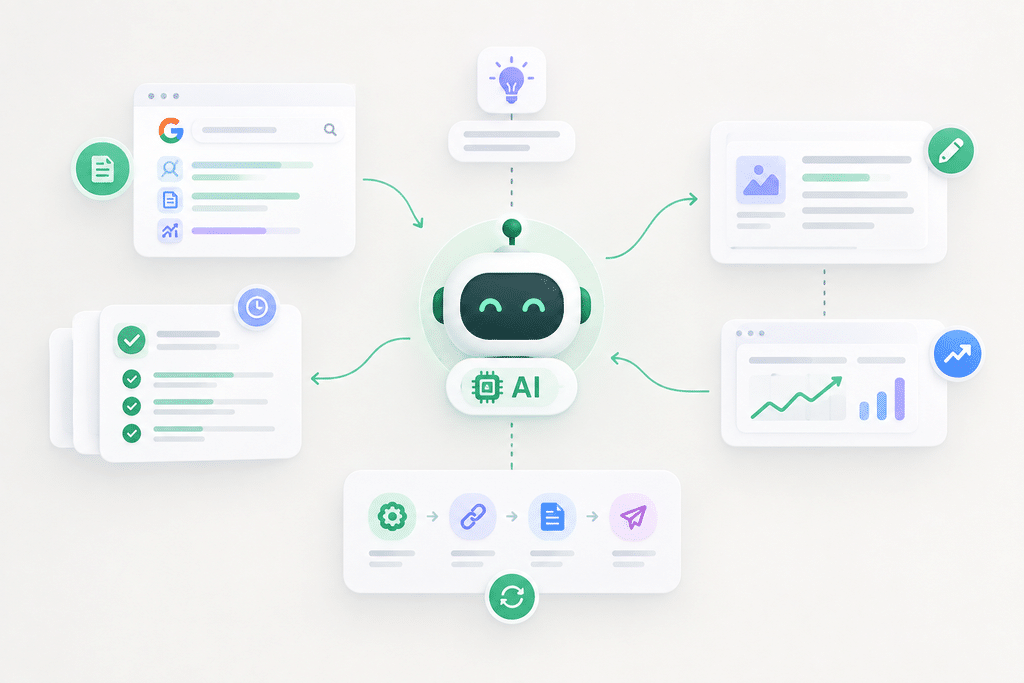
SEO automation is the use of software, AI tools, and programmatic workflows to execute SEO tasks without requiring manual input for each action. The definition that Ahrefs published in August 2026 is precise: “Automated SEO is the practice of using software to carry out SEO tasks that would otherwise be done manually. At the simple end, we’re looking at scheduling a rank tracker or weekly site audit crawl. At the complex end, an AI agent that diagnoses a traffic drop, drafts the fix, and maybe even updates the post for you in WordPress.” Both ends of that spectrum are real in 2026, and the gap between them is where most agencies either prove or expose themselves.
What changed in 2025 and 2026 is the addition of a third layer: AI visibility automation. Tools like Ahrefs Brand Radar and Semrush One now track whether your content appears in AI Overviews, gets cited by ChatGPT, or surfaces in Perplexity answers, on a schedule, without someone manually testing prompts. Traditional rank tracking told you where you ranked in Google. AI visibility automation tells you whether AI systems are citing you at all.
AI Overview citations, ChatGPT mentions, Perplexity tracking
Brand Radar, Otterly, Semrush One
What Are the 11 SEO Tasks That Should Be Automated?
Most businesses doing SEO manually are wasting between 8 and 18 hours per week on tasks that software handles faster, more consistently, and without human error. Marketing agencies using AI agents in 2026 report cutting 12 to 18 hours of repetitive work per team member weekly, with measurable ROI within 60 days of deployment, according to data cited in Lorphic’s OpenAI agents for small business guide. The 11 tasks below are the clearest candidates for automation in a modern SEO program.
Scheduled technical audits, Crawling your site weekly for broken links, redirect chains, missing meta tags, and crawl errors. Screaming Frog, Semrush Site Audit, and ContentKing all run this on autopilot.
Keyword rank tracking, Daily position monitoring for every tracked keyword, with alerts when pages drop 5 or more positions. AccuRanker and SE Ranking both handle this without manual checking.
Backlink monitoring, Real-time alerts for new and lost backlinks, flagging toxic link patterns before they become penalties. Ahrefs sends these within 24 hours of detection.
Competitor tracking, Automated alerts when a competitor gains new backlinks, publishes in your keyword categories, or changes ranking position on target terms.
Automated SEO reporting, Weekly or monthly reports generated from live Search Console and platform data, delivered directly to clients or stakeholders without anyone manually pulling numbers.
Sitemap generation and submission, Automatic sitemap updates when new pages are published and resubmission to Google Search Console without a manual step.
Content optimization scoring, Running published pages through Surfer SEO or Clearscope on a schedule to flag underperforming content before rankings drop.
Content brief automation, Tools like MarketMuse and Frase pull competitive SERP data and generate structured content briefs so writers start with data-backed direction, not guesswork.
Internal link optimization, Tools like Link Whisper scan your site and suggest relevant internal linking opportunities based on existing content, which would take hours to do manually at scale.
Local SEO automation, Automated citation submissions, review request sequences, and Google Business Profile update alerts. Covered in depth in Lorphic’s local SEO services guide.
AI citation tracking, Automated prompt testing across ChatGPT, Perplexity, Gemini, and Google AI Overviews on a weekly cycle, tracking whether and where your brand is cited.
How Do AI SEO Companies Use SEO Automation Differently?
A traditional SEO company automates tasks 1 through 5 on that list. An AI SEO company automates all 11 and connects the outputs. When a rank drop alert fires (task 2), a traditional agency manually investigates. An AI SEO company has pre-configured the alert to trigger an automated content audit (task 7), surfacing the gap and queuing a brief update (task 8) before a human even reviews it.
This connected workflow is the operational difference that separates the two categories.
Google’s AI optimization documentation confirms that generative AI search features rely on core SEO quality signals, meaning the automation that improves your traditional rankings is the same infrastructure that supports your AI citation eligibility. These are not parallel systems. Building one builds the other.
How a Legitimate AI SEO Company Deploys SEO Automation: Step-by-Step
Step 1: Baseline audit, an automated crawl maps every technical issue, content gap, and entity signal across the site before any optimization work begins.
Step 2: Tool stack connection, rank tracking, Search Console data, and content platforms are integrated into a unified reporting pipeline so data flows automatically without manual export.
Step 3: Alert thresholds, rank drop triggers, new competitor links, and content freshness flags are configured so the team is notified of issues before clients see them in traffic data.
Step 4: AI citation monitoring setup, a fixed prompt set (typically 30 to 50 buyer-relevant questions) is loaded into an AI visibility tracking tool and run weekly, with results logged automatically.
Step 5: Reporting automation, client-facing dashboards pull live data from all integrated sources and are delivered on a schedule, with no manual assembly required.
What Should Never Be Automated in SEO?
SEO automation fails in three specific areas, and any company that automates these is producing work that risks Google penalties or citation ineligibility. The NextGrowth.ai 2026 platform analysis introduced the 30% rule: AI handles 30% of strategic work and 70% of operational grunt work. Exceeding that strategic threshold consistently produces content that fails E-E-A-T evaluation, which is exactly what keeps brands out of AI citations.
Task
Why It Cannot Be Automated
What Happens When You Try
Editorial content strategy
Requires understanding of client business context, audience nuance, and competitive positioning that AI cannot reliably infer
Generic content with no topical differentiation, poor E-E-A-T signals
E-E-A-T signal building
Author credibility, original research, real client outcomes, these require actual human experience
Thin, unattributable content that AI systems skip in citation decisions
Link outreach and relationship building
Effective link acquisition depends on genuine relationship-building and relevance judgment
Identifying which AI questions matter for your specific business requires understanding buyer psychology
Irrelevant citation tracking that measures the wrong visibility surface
Automating rank tracking is safe. Automating the content strategy behind why you’re targeting those rankings is not.
How Lorphic Handles SEO Automation for Connecticut Businesses
Most Connecticut small businesses approach SEO automation backwards: they buy the tools first and figure out the workflow second. The result is a stack of subscriptions producing reports nobody reads. Lorphic’s approach starts with the AI visibility audit, a structured diagnostic that maps which SEO tasks your site actually needs automated, what the current manual process costs in time, and where automation can close a measurable gap.
From there, seo automation covers the operational layer: weekly crawls, daily rank tracking, AI citation monitoring across ChatGPT, Perplexity, and Google AI Overviews, and automated reporting that runs without anyone manually assembling a spreadsheet. Strategy, content direction, and outreach stay human. For Connecticut service businesses where marketing budgets are finite, this division between automated operations and human strategy keeps costs realistic while output quality stays consistent. If you want to know what your current SEO program would look like with proper automation applied, the AEO services guide for Connecticut covers how AI citation tracking specifically works for local businesses.
Decision Framework: Is Your Business Ready for SEO Automation?
Not every business needs the same level of seo automation. The right starting point depends on how many pages you manage, how frequently you publish, and how competitive your local market is. Use the matrix below to identify where to start.
Business Profile
Automation Priority
Start With
Local service business, under 50 pages, 1 location
Regional business, 150+ pages, active content team
Full, all 11 tasks automated in a connected pipeline
Ahrefs + Surfer + Looker Studio reporting
Agency or SaaS, high-volume publishing
Advanced, agentic automation with AI agents in the workflow
Custom AI agent setup via Lorphic or similar
For Connecticut businesses specifically: if your competitors are appearing in Google AI Overviews for your category and you are not, AI citation tracking (task 11) should be your first automation priority, not your last. That’s the clearest signal that the operational layer is missing. A structured audit via Lorphic’s local SEO services is typically the fastest way to identify that specific gap.
6 Frequently Asked Questions About SEO Automation
What is SEO automation in plain terms?
SEO automation is the use of software to handle repeatable SEO tasks, site crawls, rank tracking, backlink monitoring, content scoring, and reporting, without manual input for each action. It ranges from scheduling a weekly crawl to deploying AI agents that identify traffic drops, diagnose causes, and queue content fixes automatically.
What are the best seo automation tools in 2026?
The most widely used tools break into three categories: technical and rank tracking (Semrush, Ahrefs, SE Ranking), content optimization (Surfer SEO, Frase, MarketMuse), and AI visibility tracking (Ahrefs Brand Radar, Otterly, Semrush One). The most efficient setups in 2026 combine all three layers into a connected reporting pipeline rather than using each tool in isolation.
Can seo automation replace an SEO agency or company?
No. SEO automation handles the operational and data layer, crawling, tracking, monitoring, and reporting. It cannot replace strategic decisions: which keywords to pursue, what content angle will earn citations, how to build genuine authority in a specific market. The value of an AI SEO company is knowing which tasks to automate and which to keep human.
How much does seo automation cost for a small business?
Basic automation (rank tracking plus reporting) starts at $100 to $200 per month using platforms like SE Ranking or Semrush starter plans. Full-stack automation including AI citation monitoring and content optimization tools typically runs $400 to $900 per month in tool costs before any agency management fee. Agencies that build and manage the full stack for you typically charge an additional $1,000 to $3,000 per month on top of tool costs.
Is seo automation safe for Google rankings?
Yes, when used on the right tasks. Technical seo automation (crawling, tracking, alerting) carries no ranking risk. Content automation without human editorial review conflicts with Google’s helpful content standards and carries real risk. The 30% rule from NextGrowth.ai is the practical guide: AI handles no more than 30% of strategic work.
How does seo automation help with AI search citations?
AI citation tracking automation runs fixed prompt tests across ChatGPT, Perplexity, Gemini, and Google AI Overviews on a weekly cycle and logs whether your brand appears in the generated answers. This is the only reliable way to measure AI search visibility over time. Without automation, prompt testing is a manual process that most businesses run once and then abandon, which means they have no data on whether their content improvements are actually earning citations.
SEO automation is the operational layer that separates an AI SEO company running a real program from one managing a manual checklist at scale. For Connecticut small businesses evaluating whether their current SEO setup is properly automated, the fastest diagnostic is checking whether your provider runs AI citation monitoring alongside traditional rank tracking. If they cannot show you citation frequency data across ChatGPT, Perplexity, and Google AI Overviews, they are tracking only half the visibility surface that matters in 2026.
Curated byLorphic Digital intelligence. Clarity. Truth