
OpenArt AI character consistency is becoming the new portfolio for faceless creator brands in 2026 because repeatable characters now prove something random AI images cannot: recognizability.
In a crowded feed, polished visuals are easy to generate and even easier to forget. But a consistent character that keeps showing up across thumbnails, carousels, comics, ads, and landing pages starts doing the job a founder’s face or personal brand normally would. It creates memory.
Key takeaways
- OpenArt AI character consistency matters because recognizability now beats random visual quality. OpenArt’s current product stack explicitly supports consistent characters, model training, and reusable visual systems.
- Faceless creator brands need a repeatable visual anchor. A founder-led brand can rely on a person’s face; a faceless brand often needs a mascot, recurring protagonist, or fixed visual identity instead. This is exactly the kind of use case OpenArt highlights for brand identity and custom marketing mascots.
- The market is shifting from “make me a cool image” to “help me build something recognizable.” Google Trends says AI image generation search interest is at an all-time high, while Adobe says 85% of creators would consider AI that learns their style.
- Character consistency is becoming a better portfolio signal than one-off images. It proves continuity, not just taste. OpenArt’s higher tiers even package consistent characters and personalized models as core value.
Why does OpenArt AI character consistency matter more in 2026?
It matters more in 2026 because AI image generation is no longer rare, but recognizable AI identity still is. OpenArt now positions consistent characters, model training, and cross-format consistency as part of the product itself, which makes the platform more useful for brand-building than for one-off art alone.
A year or two ago, one impressive image could still carry a creator. That advantage is fading. Google Trends says AI image generation is searched at an all-time high, and “best AI for image generation” ranked among the top “best AI for…” searches in 2025. When everyone can generate something polished, the edge shifts to memory, repetition, and identity.
That is the real reason this topic matters. The internet is full of usable images. It is much thinner on ownable ones. OpenArt AI character consistency sits right in that gap.
What is OpenArt AI character consistency?
OpenArt AI character consistency is the platform’s ability to help users create a character from a description, one image, or training images, then keep that character recognizable across different scenes, poses, and outputs. OpenArt’s homepage and character pages explicitly describe creating consistent characters and using them across scenes.
That sounds technical, but the business meaning is simple. A consistent character can become:
- a mascot
- a narrator
- a comic lead
- a thumbnail anchor
- a visual shorthand people remember
OpenArt also ties training to brand identity, marketing mascots, storytelling, and educational use cases. That is a strong clue about where the product is headed. It is not only selling output. It is selling continuity.
Why do random AI images no longer build brand memory?
Random AI images no longer build brand memory because polish has been commoditized. Adobe’s 2025 Creators’ Toolkit Report says 86% of creators use creative generative AI, 60% used more than one AI tool in the previous three months, and 85% would consider AI that learns their creative style.
That data changes the whole conversation. If creators are using multiple tools and audiences see polished AI visuals all day, then “good-looking” stops being a moat. What starts to matter more is whether people can recognize your work later.
Here is the practical shift:
| Old advantage | New advantage |
|---|---|
| One great image | One recognizable character |
| Prompt cleverness | Visual continuity |
| Novelty | Recall |
| Range | Ownership |
| Random polish | Repeatable identity |
OpenArt AI character consistency matters because it answers the newer problem. Not “Can I make something pretty?” but “Can I make something people remember?”
How does OpenArt AI help faceless creator brands specifically?
OpenArt helps faceless creator brands by giving them a repeatable visual anchor when they do not have a founder’s face doing that job. OpenArt’s training pages explicitly mention brand identity and custom marketing mascots, which fits faceless brands almost perfectly.
This matters more than many brands realize. A faceless YouTube channel, AI comic page, niche ecommerce store, newsletter brand, or local service business often needs a recurring visual “host” to create familiarity. That can be a mascot, a fictional spokesperson, or one consistent protagonist used across posts, thumbnails, and campaign visuals.
Examples where this gets practical:
- a real estate page using one illustrated neighborhood guide
- a caterer using one recurring host character for event tips
- a tutoring brand using one educational mascot
- a faceless SaaS creator using the same founder-avatar across carousels and explainers
Once a character becomes repeatable, the brand stops looking like random content. It starts looking intentional.
Why is character consistency becoming the new portfolio?
Character consistency is becoming the new portfolio because it shows a creator can sustain identity, not just produce isolated visuals. OpenArt’s own pricing structure reinforces this idea by packaging consistent characters and personalized models as a meaningful part of tier value.
A traditional AI portfolio often says, “I made some nice images.” That is fine, but it is weaker now. A stronger portfolio in 2026 says:
- I can create a character people recognize
- I can preserve that character across scenes
- I can build a world, not just a render
- I can help a brand look connected over time
That is commercially stronger because clients, followers, and collaborators are not just buying image quality. They are buying continuity.
What are users actually frustrated by when character consistency breaks?
The real frustration is not “the image looks bad.” It is that the character stops feeling owned. Users keep running into the same practical mess: one image nails the look, then the next scene changes the face shape, softens the jawline, swaps the hairstyle, alters the outfit details, or makes the character look like a cousin instead of the same person. For faceless creator brands, that is not a minor generation issue. It kills the whole point of building a recognizable visual identity.
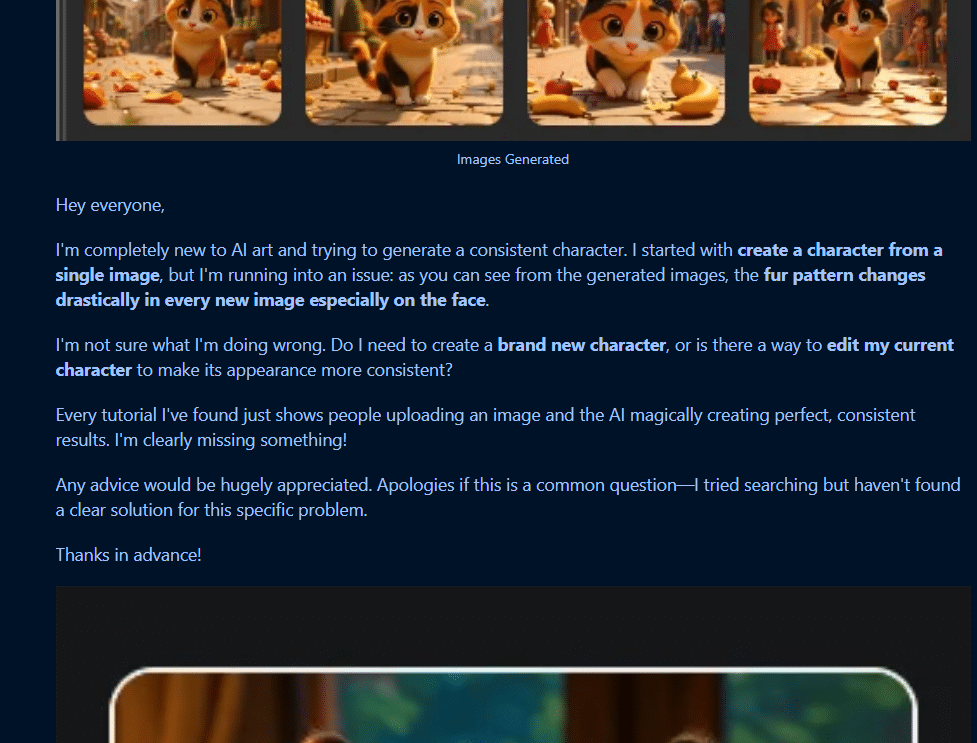
If your comic lead, mascot, or thumbnail character keeps drifting every time the camera angle changes, you are not building memory, you are resetting it. That is why consistency matters so much here. The problem users are trying to solve is not better art. It is making the same branded character survive across content without losing its identity.
How does OpenArt AI model training turn characters into brand assets?
OpenArt AI model training turns characters into brand assets by making them reusable across multiple content types and campaigns. OpenArt says users can train custom characters and styles for branding, storytelling, marketing, and unique projects.
Once that happens, a character stops being a one-off image and starts functioning like infrastructure. It can show up in:
- landing pages
- email illustrations
- comic strips
- reels and shorts thumbnails
- digital products
- local promotional campaigns
- repeat ad concepts
This is where the phrase “new portfolio” starts to make sense. A creator with one strong trained character system is often more commercially useful than a creator with twenty disconnected pretty images.
What decision framework should brands and creators use before choosing this route?
Use character consistency if your brand needs recognition across repeated content, not just occasional visuals. Skip it if your use case is one-off experimentation or random inspiration boards.
Is OpenArt AI character consistency the right play?
| Question | If yes | If no |
|---|---|---|
| Do you publish repeatedly in the same niche? | Consistency can compound brand memory | One-off visuals may be enough |
| Do you run a faceless brand? | A recurring character can replace the founder-face function | You may rely more on personal identity |
| Do you need a mascot, guide, or narrator? | Character consistency is a strong fit | A broader style system may matter more |
| Do you sell education, stories, products, or campaigns? | Reusable characters can support monetization | The value may be lower |
| Do you want recognizability more than novelty? | Invest in consistency | Stay flexible and experimental |
Good-fit scenarios
- faceless YouTube channels
- AI comics and episodic storytelling
- kids’ or education brands
- ecommerce brands with mascot-led content
- local businesses that need visual repetition on a small budget
Poor-fit scenarios
- moodboard-only creators
- trend-chasing meme accounts
- one-time campaign users with no recurring identity plan
What should the first 30 days of an OpenArt AI character consistency strategy look like?
The first 30 days should focus on defining one memorable character, training or generating it carefully, then testing it across three to five repeatable use cases. OpenArt provides tutorials, training options, and character tools that support this phased approach.
Week-by-week plan
Week 1: Define the character
- choose the role: mascot, narrator, guide, founder-avatar
- lock the visual rules: hair, colors, clothes, props, mood
- decide where it will appear first
Week 2: Build the base in OpenArt
- create from description or one image
- test multiple expressions and angles
- save what feels most stable
Week 3: Expand across formats
- thumbnail
- carousel cover
- email header
- landing-page visual
- simple story panel
Week 4: Audit consistency
- does the character still feel like the same person?
- do the colors and props hold up?
- would someone recognize it without your logo?
This is also where local specificity helps. A Dallas realtor’s guide character should feel different from a Brooklyn bakery mascot or a Dubai tutoring brand avatar. The best character systems do not just repeat. They repeat in a context that feels native to the audience.
What is the final verdict on OpenArt AI character consistency in 2026?
OpenArt AI character consistency is valuable in 2026 because recognizability is starting to matter more than raw image novelty. OpenArt’s current product direction, pricing structure, and training features all point toward repeatable creative identity as a core use case.
This is the real takeaway.
The strongest faceless creator brands are not winning because they generate the prettiest random images. They are winning because they build something audiences can recognize without checking the username.
That is why OpenArt AI character consistency is becoming the new portfolio for faceless creator brands in 2026.
FAQs
What is OpenArt AI character consistency?
It is OpenArt’s ability to help users create a recognizable character and reuse that character across scenes, poses, and outputs.
Can OpenArt AI create a character from one image?
Yes. OpenArt says its character tools can create consistent characters from one image or a description.
Is OpenArt AI only useful for artists?
No. OpenArt explicitly mentions branding, marketing mascots, storytelling, and education as use cases, which makes it relevant to businesses and creators too.
Why does character consistency matter more than random image quality?
Because polished visuals are easier to generate now, while recognizable visual identity is still harder to build and easier to monetize.
Are creators actually struggling with consistency?
Yes. Public creator discussions on Reddit-style communities and OpenArt workflows repeatedly focus on character drift, pose changes, and keeping the same subject recognizable across images.
Does OpenArt pricing show that consistency is a core value?
Yes. OpenArt’s pricing page includes consistent characters and personalized models as part of tier value, which suggests repeatability is central to the product, not just an extra feature.
Finally,
That is why OpenArt AI character consistency is becoming the new portfolio for faceless creator brands in 2026. It is not just helping creators make better visuals. It is helping them build something audiences can recognize, remember, and trust. In a market full of polished sameness, the brands that win are not the ones generating more. They are the ones repeating something worth remembering.
Curated by Lorphic
Digital intelligence. Clarity. Truth.
Last Updated: 10, 2026.