

Connecticut businesses are losing visibility they never knew they had. Not on Google’s first page. On something newer. When a potential customer asks ChatGPT which accounting firm serves Fairfield County, or asks Perplexity to recommend a Hartford-based HVAC contractor, the business that appears is not necessarily the one that ranks highest in organic search. It is the one whose content was structured to be cited. AEO services (Answer Engine Optimization) address exactly this gap. This page explains what those services include, how the process works, who needs it, what it realistically costs, and what outcomes are and are not guaranteed.
Key Takeaways
- AEO improves AI visibility: AEO helps make your business information and content easier for AI-powered search systems to understand, extract, and reference.
- AEO works with SEO: Strong technical SEO, useful content, clear business information, internal linking, and accessibility remain important for AI search visibility.
- Content structure matters: Direct answers, clear headings, specific information, and question-focused content make important information easier for both users and search systems to find.
- Local context is important: Connecticut businesses should clearly communicate their services, locations, and service areas so AI systems can better understand their geographic relevance.
- Citations cannot be guaranteed: No ethical AEO provider can promise that ChatGPT, Google AI Overviews, Perplexity, Gemini, or another platform will cite a specific business.
- Measurement should be transparent: A good AEO strategy tracks AI visibility, citation patterns, relevant queries, technical improvements, and other measurable indicators rather than relying on vague claims.
What Is AEO, and Why Does It Matter Now?
Answer Engine Optimization (AEO) is the practice of improving digital content so it can better answer the questions people ask through search engines and AI-powered answer experiences.
Traditional SEO is largely concerned with helping a webpage appear prominently in search results. AEO puts additional attention on how clearly information answers a specific question, whether important facts are easy to extract, and whether the business is clearly represented across relevant online sources.
The terminology is still evolving. Some agencies use AEO, while others use terms such as Generative Engine Optimization (GEO), AI SEO, or AI Search Optimization. The labels can overlap, so businesses should focus on the actual strategy rather than the acronym. For Connecticut businesses, the opportunity is practical. A potential customer may search for a local service, ask an AI system to explain a problem, compare several providers, or look for businesses serving a particular city or county.
If your website clearly explains what you do, who you serve, where you operate, and the questions your customers need answered, it gives search systems more useful information to work with.AEO is therefore not about finding a secret formula for getting mentioned by AI. It is about building a clearer, more useful, and better-supported digital presence. see guide How to Choose an AEO Agency in Connecticut: A Practical Buyer’s Guide
What Do AEO Services Actually Include?
AEO services are not a single deliverable. A credible engagement covers several distinct areas, each targeting a different aspect of how AI systems evaluate and extract content.
Content audit and gap analysis. The starting point is a structured review of existing content against the questions AI systems are actually surfacing for your category. This is different from a standard keyword gap analysis. The relevant questions here are: which queries in your category trigger AI Overviews or Perplexity summaries? Is your content being cited, and if not, what is being cited instead? What questions are competitors answering that you are not?
Content restructuring and creation. AI systems favor content that front-loads its answer. Research analysis from Superlines, cited across multiple industry studies, found thatAnswer-first structure can make important information easier for readers and search systems to find, but there is no universal word count or placement formula that guarantees AI citations. That means a well-written 2,000-word article where the main answer is buried in paragraph eight is structurally disadvantaged compared to a 900-word piece that answers the question in the opening lines, even if the longer article is substantively better. AEO content work reshapes existing assets and creates new ones with this extraction logic built in.
Structured data and schema implementation. Structured data can help search engines understand important information about a page, organization, service, or business. Relevant schema types may support clearer search interpretation when they accurately reflect visible page content, but there is no special schema markup that guarantees inclusion or citations in Google AI Overviews or other AI search experiences. AEO work should therefore treat structured data as a supporting technical signal, alongside useful content, crawlability, clear entity information, and strong search fundamentals, rather than as a shortcut to AI visibility.
Entity optimization. AI systems resolve information to named entities: specific businesses, people, locations, products, and organizations. If your business is ambiguously described across your own site, third-party directories, Google Business Profile, and industry listings, AI systems have less confidence in recommending you. Entity optimization means ensuring that your business identity is consistent, clearly described, and corroborated across multiple independent sources. This is particularly important for Connecticut businesses targeting specific service areas, since location-specific entity clarity helps models associate your brand with relevant geographic queries.
Citation tracking and AI visibility measurement. Effective AEO services include a measurement component. This involves monitoring which AI platforms are citing your content, tracking referral traffic from sources like perplexity.ai and chatgpt.com Referral traffic from AI platforms can sometimes be identified in analytics, but attribution is incomplete because many AI-influenced journeys do not result in a direct referral making attribution in GA4 more straightforward), and running systematic prompt testing across target query categories. Measurement is an ongoing process, not a one-time audit, because AI citation patterns shift as platforms update their models and retrieval logic.
BrightEdge’s research has tracked the expansion and behavior of AI Overviews across search results, providing useful context for businesses evaluating their visibility in AI-powered search. BrightEdge
Third-party corroboration strategy. A consistent finding across citation research is that AI systems prefer brands with multi-source validation. Research from Profound and SEMrush indicates that Consistent information across credible third-party sources can strengthen a business’s overall online authority and make its identity easier to verify across search and AI systems A business that appears coherently across its own site, industry publications, local news, Google Business Profile, and credible directories is treated as more trustworthy than one that only exists on its own domain. Part of AEO work involves identifying the corroboration gaps and addressing them through PR, local listings, and content distribution.
How the Process Works
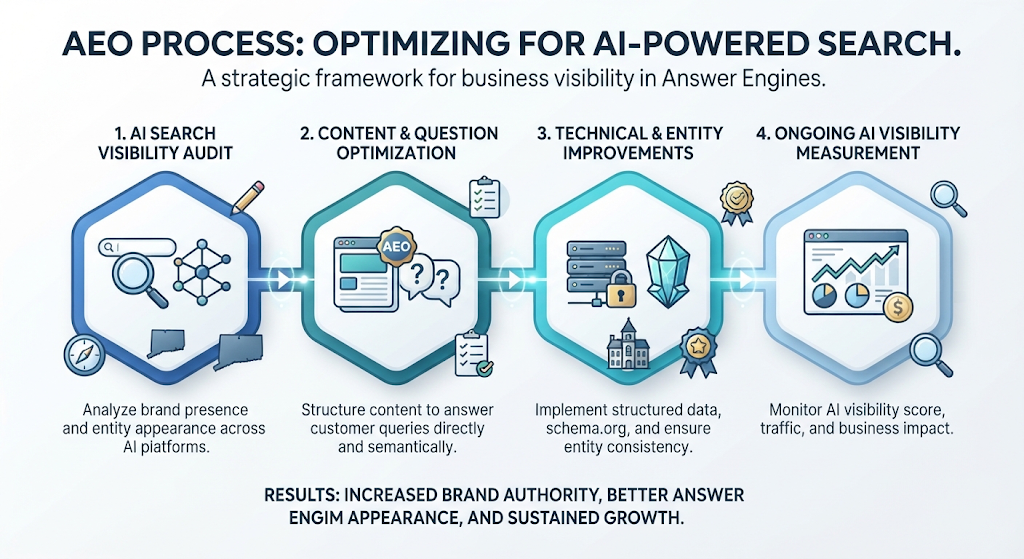
A structured AEO engagement typically follows four phases, though the specifics vary by provider and scope.
The first phase is discovery: prompt testing across target query categories, citation analysis to identify which competitors are being cited and why, a content inventory mapped against AI-surfaced questions, and a technical review of existing schema and crawlability.
The second phase is prioritization: ranking opportunities by potential impact, competitive difficulty, and alignment with your actual service offerings. Not every query category is worth pursuing. In some categories, AI citations are difficult to earn regardless of content quality because the systems strongly favor established media brands over individual business websites. Honest prioritization means identifying the achievable wins first.
The third phase is implementation: content creation and restructuring, schema deployment, entity consistency work, and where applicable, a content distribution plan to build third-party corroboration.
The fourth phase is ongoing measurement and iteration. AI citation patterns change. Google’s AI Overview selection logic has shifted several times in the past twelve months alone. Treating AEO as a one-time project rather than an ongoing program produces diminishing returns.
Who Needs AEO Services in Connecticut?
Not every Connecticut business has the same AI visibility exposure. The need is strongest in categories where AI Overviews already trigger frequently and where buying decisions involve research before contact.
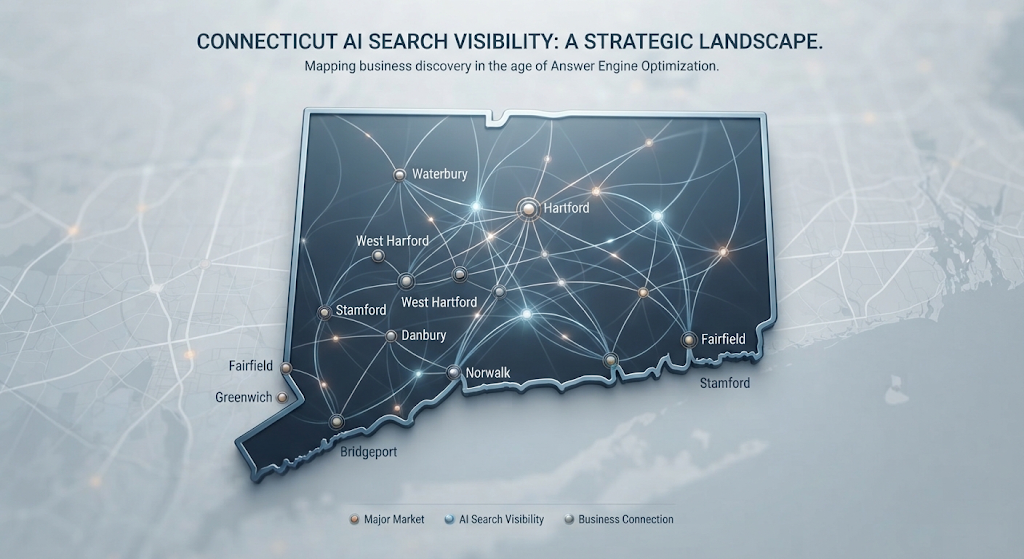
Professional services (attorneys, accountants, financial advisors, insurance brokers) are high-exposure categories. Prospective clients often ask AI systems to explain a concept, compare options, or recommend local providers before ever searching for a specific firm. Bridgeport, New Haven, Stamford, and Hartford each have dense concentrations of these practices operating in markets where the difference between being cited and being invisible directly affects inbound lead quality.
Healthcare and medical practices face a category where (BrightEdge, 2026 industry data). Patients researching symptoms, treatment options, or local specialists are increasingly getting their first-pass information from AI summaries. A Connecticut medical group or specialty clinic that is not structuring content for AI citation is effectively absent from a large and growing portion of patient research behavior.
Home services (HVAC, roofing, plumbing, electrical, landscaping) are a strong fit for local AEO work, particularly entity optimization and Google Business Profile alignment. AI systems serving location-specific queries rely heavily on entity clarity and third-party corroboration from review platforms and local directories.
B2B companies in Connecticut’s manufacturing, logistics, and technology sectors are earlier in AI visibility maturity but face growing exposure as procurement research moves toward AI-assisted discovery. An industrial manufacturer in the New Haven area or a software company in Stamford faces the same structural question as any service business: when a procurement manager asks an AI tool for vendor options in their category, does your company appear?
The businesses with the least immediate urgency are those in product categories where AI Overviews rarely trigger (e-commerce in some verticals, for example), or those whose customer acquisition is dominated by referral and repeat business with minimal discovery-phase research.
For local businesses in communities such as Guilford, New Haven, Stamford, Hartford, and other Connecticut markets, clear service-area information can help establish stronger geographic context.
How AEO Fits Alongside SEO, GEO, and AI Search Optimization
The terminology in this space is genuinely unsettled, which creates confusion for businesses evaluating services. Here is a working framework that avoids both oversimplification and unnecessary complexity.
SEO (Search Engine Optimization) remains foundational. Organic ranking and AI citation are not the same thing, but they are related. Google’s AI Overviews still draw from Google’s index, and a site with poor technical SEO, thin content, and weak authority signals is less likely to earn AI citations regardless of how well the AEO-specific work is executed. SEO is a prerequisite, not a competitor.
AEO (Answer Engine Optimization) targets the specific surfaces where direct answers are delivered: featured snippets, AI Overviews, and conversational AI platforms. It focuses on content structure, extractability, schema, and question-answer format.
GEO (Generative Engine Optimization) is a broader discipline that encompasses AEO but extends to any generative AI output, including models that do not operate as search engines. GEO is commonly used as a broader term for improving a brand’s visibility and representation across generative AI experiences.
AI SEO and AI Search Optimization are terms used interchangeably by different providers to describe roughly the same scope as GEO. There is no meaningful functional difference between them; the variation is in labeling, not in methodology.
For a Connecticut business evaluating these services, the practical question is not which acronym to prioritize. It is whether a prospective provider can explain, specifically and with evidence, what they will do and how they will measure whether it worked. Any provider who cannot describe their citation measurement methodology in concrete terms is either newer to the discipline or less transparent than the situation warrants.
| Term | Primary Focus | Surfaces Targeted |
|---|---|---|
| SEO | Rankings in organic search | Google, Bing blue links |
| AEO | Direct answers and citations | Featured snippets, AI Overviews, ChatGPT, Perplexity |
| GEO | Brand presence in generative AI outputs | All LLM-based systems, AI search, model training |
| AI SEO / AI Search Optimization | Visibility in AI-driven search | AI Overviews, Perplexity, Copilot, Gemini |
These disciplines overlap significantly. An AEO engagement that excludes SEO fundamentals produces weaker results. A GEO strategy that ignores content structure produces the same.
What Helps Content Perform in AI Search?
There is no publicly available formula that guarantees an AI system will cite a particular webpage. Different platforms use different systems, and their responses can change over time.
However, several practical content and technical fundamentals can make information easier for search systems to understand and use.
Answer the Question Clearly
Lead with the information the reader actually needs. If a page is designed to answer a specific question, don’t make the reader work through several paragraphs before reaching the answer.
Use Specific, Verifiable Information
Avoid vague claims such as “experts agree” or “studies prove” unless you can identify the source. Specific explanations, accurate facts, examples, and appropriate citations make content more useful and easier to evaluate.
Organize Content Around Real Questions
Descriptive headings, short sections, lists, tables, and direct answers can make complex information easier for both readers and search systems to navigate.
Establish Clear Business Context
Make it obvious what the company does, which services it provides, which customers it serves, and which Connecticut locations or service areas it covers.
Keep Business Information Consistent
Important information such as the business name, services, locations, and contact details should be accurate across the website and legitimate external profiles.
Make the Website Accessible to Search Engines
Search systems need to be able to access and process your content. Technical SEO, crawlability, indexability, site structure, and page performance therefore remain important parts of an AI-search strategy.
Build Real Authority
Useful third-party references can strengthen a business’s overall online presence, but the goal should be legitimate recognition—not manufactured mentions or artificial attempts to influence AI responses.
These practices do not guarantee AI citations. They simply create the type of clear, useful, and trustworthy information that serves both customers and modern search experiences.
AEO Pricing: What Affects Cost
AEO pricing varies because businesses need very different levels of work.
A small Connecticut service business with a 15-page website may only need an audit and optimization of its most important service pages. A larger company with hundreds of pages, several locations, and an established content program may need ongoing monitoring, content development, technical work, and broader entity management. Instead of choosing an AEO provider based only on the monthly price, compare the scope of the engagement.
| AEO Engagement | What It May Include |
|---|---|
| AEO Audit | AI visibility review, content assessment, technical findings, and prioritized recommendations |
| One-Time AEO Optimization | Audit plus content restructuring, technical improvements, internal linking, and appropriate structured data |
| Monthly AEO Services | Ongoing content optimization, new content, AI visibility monitoring, testing, and reporting |
| Local AEO Services | Local content, business information, service-area optimization, and local visibility monitoring |
| Enterprise AEO | Larger content inventories, multiple locations, broader technical work, advanced reporting, and ongoing strategy |
What Determines the Cost?
Website size: More pages usually mean more content to audit, improve, and monitor.
Content quality: A website with strong existing content may need refinement, while thin, outdated, or inaccurate content can require substantial redevelopment.
Technical complexity: Multiple locations, complicated website structures, CMS issues, or technical SEO problems can increase the workload.
Monitoring requirements: Basic reporting requires less ongoing work than systematic prompt testing, competitor monitoring, and platform-by-platform visibility tracking.
Content production: New service pages, educational articles, FAQs, comparison content, and location-specific resources require additional research and writing.
Competition: A business competing in a crowded Connecticut market may require more extensive research and content development than a company operating in a highly specialized niche.
How to Compare AEO Proposals
Before signing a contract, ask each provider:
- What exactly is included?
- How many pages will be audited or optimized?
- Will you improve existing content or only create new content?
- What technical SEO work is included?
- Which AI search platforms will you monitor?
- How will AI visibility be measured?
- How frequently will I receive reports?
- What work is excluded from the quoted price?
- Which outcomes can you reasonably influence?
- Which results are outside your control?
A lower-priced proposal is not necessarily the better deal.
The better proposal is the one that gives you a clear scope of work, realistic expectations, transparent reporting, and a strategy connected to your actual business goals.
What to Expect: Realistic Outcomes and Honest Limitations
Being specific about what AEO can and cannot deliver is more useful than optimistic framing, and it reflects how the discipline is actually practiced by credible providers.
What AEO can reasonably be expected to improve: AI visibility measurement clarity (you will know, with specificity, where you are and are not being cited), content quality signals that support both traditional SEO and AI citation, schema coverage and technical accessibility, entity consistency across your digital footprint, and a documented baseline for tracking change over time.
What AEO does not guarantee: No ethical provider can guarantee that your content will appear in ChatGPT’s responses, Perplexity’s citations, or Google AI Overviews. Citation selection is determined by AI platforms’ retrieval systems and model logic, which are not fully transparent and which change frequently. Providers who guarantee citation frequency or AI traffic increases are making promises they cannot keep.
Timeline expectations. Changes in AI citation patterns are faster to measure than traditional SEO rank changes, but meaningful improvement in citation frequency typically develops over three to six months of consistent work. Initial technical improvements (schema, crawlability, content structure) can register more quickly. Building third-party corroboration takes longer.
Attribution complexity. Measuring the business impact of AEO requires a realistic measurement setup. Referral traffic from AI platforms is trackable in Google Analytics 4, but AI-influenced searches that do not result in a click (queries where someone saw your brand cited in an AI summary and later searched for you directly) are harder to attribute. Honest reporting acknowledges this attribution gap rather than claiming credit for organic traffic changes that may have multiple causes.
Frequently Asked Questions
What is the difference between AEO and SEO?
SEO focuses on earning high rankings in traditional search engine results pages so users find and click on your website. AEO focuses on structuring content so AI-powered answer systems cite it directly in their responses, without requiring a user to navigate to your site. The two disciplines are complementary rather than competing. Solid SEO fundamentals remain a prerequisite for effective AEO, but they target different surfaces and require different content strategies.
Can any business earn AI citations, or do you need to be a large brand?
Smaller businesses and regional operators can and do earn AI citations, particularly for location-specific or niche-category queries where large national brands are not competing. For Connecticut businesses serving defined geographic markets (attorneys in New Haven, contractors in Fairfield County, healthcare practices across Hartford) the competitive set in AI citation is often regional rather than national, which creates realistic opportunities for well-structured content to perform. That said, certain query categories are dominated by high-authority publishers regardless of business size, and a credible provider will be transparent about which opportunities are achievable.
How do I know if my business is currently being cited by AI systems?
The most direct method is systematic prompt testing: querying ChatGPT, Perplexity, Gemini, and Google AI Overviews with the questions your target customers are likely to ask, and documenting which sources appear. In Google Analytics 4, filtering referral traffic from perplexity.ai and chatgpt.com provides a quantitative measure of citation-driven visits. Several third-party tools (including Profound, Goodie AI, and others) offer more systematic AI visibility monitoring. An AEO audit typically begins with this baseline assessment.
Does AEO work replace the need for traditional SEO?
No. Strong SEO remains foundational, especially for Google AI Overviews, which still draw primarily from Google’s indexed content. A site with weak domain authority, poor technical performance, or thin content will not earn AI citations regardless of how well the AEO-specific elements are executed. The practical reality is that most of what makes content good for traditional SEO (clear structure, specific claims, authoritative sourcing, real depth) also makes it better for AI citation. The optimization work is largely additive rather than competing.
What should I look for when evaluating an AEO service provider?
Ask specifically: how do they measure AI citation changes, what is their methodology for content structuring, do they report on citation frequency by platform, and how do they handle the attribution gap between AI-influenced searches and direct traffic? Credible providers will have clear answers to all four. Be cautious of providers who guarantee citation volume, claim proprietary access to AI platform selection logic, or cannot describe their measurement process in plain language.
How does AEO apply to local and regional businesses specifically?
For Connecticut businesses serving defined geographic markets, local AEO involves several elements that national brands often do not need. These include entity consistency across Google Business Profile, local directories, and third-party review platforms; location-specific content that gives AI systems clear geographic context; and corroboration from local press and industry associations. AI systems serving location queries use both structured entity data and contextual content signals to resolve which businesses serve which areas, and a business that is clearly and consistently described across both is better positioned to appear in location-specific AI responses than one whose geographic coverage is ambiguous.
Working With an AEO Provider in Connecticut
For Connecticut businesses, AEO should start with understanding how your business is currently represented across search and AI-powered answer experiences. Before investing in a long-term program, an AI search visibility audit can provide a useful starting point.
The audit can examine:
- Which questions are relevant to your customers
- How your business currently appears in AI-powered search
- Which competitors are being mentioned
- What information is missing or unclear on your website
- Whether your services and locations are clearly represented
- Which pages have the strongest opportunities for improvement
- What technical or content issues should be addressed first
From there, an AEO strategy can focus on the improvements that have the clearest connection to your customers and business goals.If you are looking to understand where your Connecticut business currently stands in AI search, Lorphic can help assess your existing visibility and identify practical opportunities for improvement. The objective isn’t to promise a specific AI citation or ranking.It is to make your business easier to understand, easier to find, and better represented across the search experiences your customers increasingly use.
Curated by Lorphic
Digital intelligence. Clarity. Truth