

AEO vs SEO is not an either-or decision for Connecticut businesses. SEO helps businesses build visibility in traditional search, while AEO focuses on how content may be surfaced in AI-generated answers. If you run a business in Connecticut and you are already doing some form of SEO, you have probably started hearing about AEO. The question most owners and marketing managers actually want answered is simpler than the jargon suggests: do I need to add this to what I am already doing, and if so, when? The honest answer is: it depends on your category and your current organic foundations.
This post breaks down what each discipline does, where they overlap, where they differ, and how to make a sensible call.
Key Takeaways:
- SEO earns rankings and clicks. AEO earns citations inside AI-generated answers. They measure success differently and need separate reporting setups.
- The two disciplines share real ground: content quality, technical health, and E-E-A-T signals benefit both. Weak SEO foundations actively hurt AEO results.
- AEO can surface citations faster than SEO produces rankings, but neither outcome can be guaranteed. Citation selection is controlled entirely by the AI platforms.
- Research-heavy categories like professional services, healthcare, and B2B have the most to gain from running both, because buyers in those categories use AI tools before they ever search for a specific business.
- Expanding from SEO into AEO does not require rebuilding everything. The additions are targeted: content restructuring, schema markup, and a GA4 channel for AI referral traffic.
What SEO and AEO Are Actually Trying to Do
SEO (Search Engine Optimization) gets your pages to rank in Google and Bing so people click through to your site. It works through crawlability, content relevance, keyword targeting, and authority signals. You measure it in rankings, traffic, and conversions.
AEO (Answer Engine Optimization) gets your content cited by AI-powered answer systems, including ChatGPT, Perplexity, Google AI Overviews, and Gemini, when those systems respond to user questions. The goal is not a click. It is a citation. Does your business appear as a source when someone asks an AI platform a question in your category?
These are genuinely different goals. As Optimizely notes, SEO helps search engines find your content while AEO helps AI understand and use it. The two overlap more than people expect, but they also diverge in ways that matter for budget decisions.
Where They Overlap
Content quality is the most important overlap. A page that answers a question clearly, leads with the point, and is organized in readable sections performs better in both traditional search rankings and AI citation. Google rewards it for relevance and user experience. AI systems extract from it because the structure makes that easy.
Technical health is another area that benefits both. A fast, crawlable, properly indexed site supports organic rankings and AI citation simultaneously. Google AI Overviews draw from Google’s existing search index, so the technical foundations that matter for SEO also matter for AEO on that platform.
E-E-A-T signals (Experience, Expertise, Authoritativeness, Trustworthiness) apply across both disciplines. Content from a named expert, backed by credible sources, on a domain with genuine authority performs better in search and earns more AI citations.
The practical takeaway: weak SEO foundations will hold back AEO results. A Danbury B2B manufacturer with thin content, slow site speed, and no meaningful external authority will not earn AI citations regardless of how the AEO-specific work is executed.
AEO vs SEO Where They Genuinely Differ
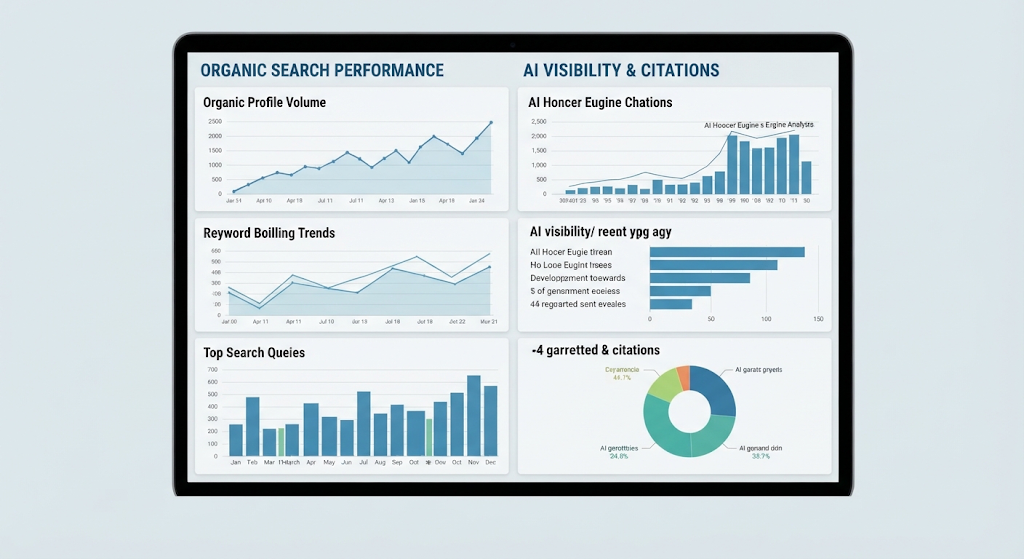
Measurement. SEO lives in Google Search Console and GA4: rankings, sessions, click-through rate, conversions. AEO lives in prompt testing logs, referral traffic from perplexity.ai and chatgpt.com, and competitive share of AI mentions in your category. Different tools, different data sources, different reporting cadence.
How content is built. SEO content tends to cover a topic comprehensively to earn rankings across related queries. AEO content prioritizes the opening answer, uses question-based headings, and writes in self-contained paragraphs that AI systems can lift without surrounding context. The outputs can look similar, but the drafting logic is different.
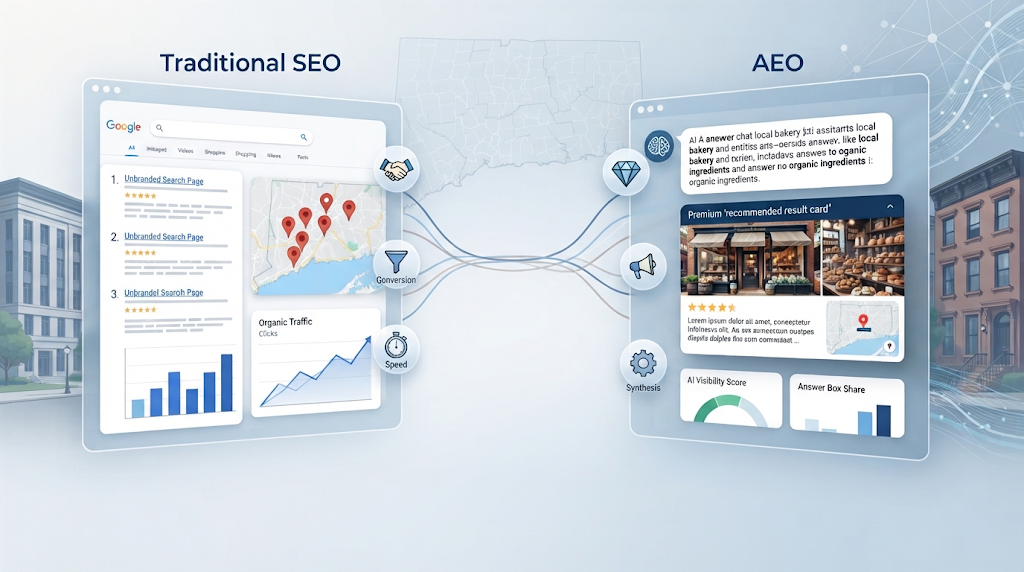
External validation. Backlinks from authoritative domains drive SEO rankings. For AEO, the equivalent is third-party corroboration: your business appearing consistently across directories, local press, review platforms, and industry listings. Both require external signals, but the sources and mechanisms differ.
Timeline. SEO typically takes six to twelve months before competitive ranking improvements appear. AEO citations can start appearing within thirty to sixty days of structural content improvements, though stable citation frequency takes longer to build, as NovaStacks’ 2026 breakdown of real citation timelines confirms. SEOProfy’s 2026 analysis found that AI-referred sessions grew 527% year-over-year in 2025, so the channel is expanding fast even if individual timelines vary.
Control. With SEO, targeting a low-competition keyword with good content will eventually produce results. With AEO, citation selection is entirely in the hands of the AI platforms. No provider can guarantee that your content will appear in any specific AI response. That is not a caveat to bury in footnotes; it is a structural reality that should shape how you evaluate any AEO proposal.
Which Connecticut Businesses Should Prioritize SEO First
For most businesses without solid organic foundations, SEO comes first. There is not much point in AEO work on a domain that Google barely indexes.
A Waterbury retail business with a new site and low organic traffic needs crawlability, backlinks, and core content before AI citation is achievable. AI systems are unlikely to cite a domain that does not already carry some search authority.
Businesses with purely transactional local search intent also get more immediate value from SEO. If your customers are typing “Norwalk electrician” or “plumber near me” into Google, traditional local SEO signals (Google Business Profile, reviews, proximity, citations) are still the primary lever. AEO adds value, but it is a layer on top of something that should already be working.
Categories where AI Overviews rarely trigger are similarly less exposed to the AEO opportunity. Highly transactional product searches and some e-commerce queries still resolve primarily in traditional results.
Which Connecticut Businesses Should Prioritize AEO Now
The case for adding AEO to an existing SEO strategy is strongest when:
Buyers in your category research before contacting you. A personal injury attorney in Norwalk, a financial planner in Danbury, or a specialist medical practice in Waterbury serves clients who typically research extensively before making the first call. AI search is already part of that research for this type of buyer. Being visible in AI-generated answers means reaching those prospects earlier in their decision process, before they start comparing websites.
Your category produces AI-generated recommendations. Test it directly: run ten queries across ChatGPT, Perplexity, and Google AI Mode for your service type in your Connecticut market. If AI systems are generating specific business recommendations and your business is not appearing, the competitive gap is measurable and addressable.
Your traditional SEO foundation is already working. AEO builds on the foundation that SEO creates. If your business is not yet ranking in the Google Maps Local Pack for primary service keywords, has inconsistent citation data, or has not established a review acquisition process, those foundational gaps take priority. AEO work on a broken foundation produces weak results.
The case for focusing on SEO first and adding AEO as a secondary benefit of that work applies to businesses earlier in their local search journey. For most small businesses in New Britain or similar markets with strong local roots but limited digital presence, a well-executed local SEO program that includes the entity consistency, GBP optimization, and structured content that AEO requires is the right starting investment.
How an Existing SEO Strategy Expands Into AEO
AEO vs Seo does not require starting over. For most businesses, the expansion involves three additions to existing work.
First, audit which queries in your category are triggering AI-generated answers rather than traditional results, and identify whether your content appears in those answers. Second, restructure existing high-traffic pages to front-load direct answers and add question-based subheadings. This improves AI extractability without hurting organic rankings. Third, add FAQ schema, Article schema, and where relevant LocalBusiness schema to pages already performing well in search.
For a Norwalk professional services firm already running a content program, this means taking the best-performing pages and restructuring them for AI citation. The research, authority, and topic coverage are already there. The work is largely architectural, not additive.
The measurement side is straightforward: set up a GA4 channel for AI referral traffic alongside the organic channel, and run periodic prompt tests across ChatGPT, Perplexity, and Google AI Overviews to track citation frequency over time.
How to Make the Investment Decision
Use this sequence before committing to any new investment:
- Check your SEO foundation. Do you appear in the Google Maps Local Pack for your primary service keywords? Is your NAP data consistent across platforms? Do you have recent reviews? If not, fix these first.
- Test your current AEO position. Run 10 to 15 queries across AI search platforms for your service category and market. Document whether you appear and whether you are named. This is your baseline.
- Assess your buyer behavior. Do your customers research before contacting you? Is your category producing AI-generated recommendations? If yes to both, the case for AEO investment alongside continued SEO is strong.
- Define what you are buying. Any provider offering AEO or AI visibility services should be able to specify exactly what they will deliver: entity audit, content restructuring, prompt-testing protocol, monthly reporting with GSC AI Overview data. If the deliverables are vague, the service is likely repackaged SEO under a new name.
For businesses that want professional help navigating this decision for their specific Connecticut market, Lorphic’s current packages are at lorphic.com/deal.
Frequently Asked Questions
What is the main difference between AEO and SEO?
SEO gets your pages to rank in search engines so users click through to your site. AEO gets your content cited by AI systems like ChatGPT, Perplexity, and Google AI Overviews when those systems answer relevant questions. SEO drives traffic. AEO drives citations and AI-based brand visibility. Both matter, and neither replaces the other.
Does investing in AEO mean I can stop doing SEO?
No. SEO remains foundational for AEO to work, particularly for Google AI Overviews, which pull from Google’s existing search index. A site with poor organic authority, thin content, or technical issues will not earn meaningful AI citations regardless of how much AEO-specific work is done. Build SEO foundations first and add AEO work on top.
How quickly does each discipline produce results?
SEO typically takes six to twelve months before meaningful ranking improvements appear for competitive queries. AEO citations can start showing up within thirty to sixty days of content restructuring, though stable citation frequency across platforms takes longer to build. Neither SEO rankings nor AI citations can be guaranteed on any timeline.
Is AEO relevant for small local businesses in Connecticut?
It depends on the category. A small Norwalk or Waterbury service business where buyers research online before making contact has real AEO exposure. A business that runs primarily on referrals and repeat customers has less urgency. The question is not whether the business is small. It is whether AI tools are part of how prospective customers make decisions in that category.
Can an agency guarantee AI citations or search rankings?
No. AI citation selection is controlled by the AI platforms themselves, and their retrieval logic is not fully transparent. Search rankings are determined by algorithms that also change. Credible providers improve the signals that support both outcomes and measure progress honestly, but neither discipline offers guaranteed results.
What should I look for when hiring someone to handle both SEO and AEO?
Ask how they measure each discipline separately, because the metrics are different. Ask specifically how they track AI citation frequency across ChatGPT, Perplexity, and Google AI Overviews. Be cautious of providers who treat SEO and AEO as the same thing or who cannot explain their measurement methodology in plain terms.
Working With Lorphic
Lorphic works with Connecticut businesses on both SEO and AEO. If you are unsure which investment fits your situation, an AI visibility audit is a practical first step: it shows where you currently stand in AI search before you commit to a program.
The AEO services for Connecticut businesses overview covers who needs AEO work and what realistic outcomes look like. The AEO checklist breaks down each optimization area in detail. And what AEO is in digital marketing is a clear primer if you are still building your understanding of the discipline.
Curated by Lorphic
Digital intelligence. Clarity. Truth