

ChatGPT ads vs Google Ads is not a question most small businesses expected to be asking in 2026. ChatGPT Ads launched January 16, 2026, and by end of August OpenAI reported it had reached a $1 billion annualised revenue run rate in under 200 days.
For a Waterbury plumber or a Norwalk accounting firm already running Google Ads, the question is practical: add ChatGPT, stay with what it knows, or simply watch? This guide compares the two on the factors that matter for a local service business.
Key Takeaways
- ChatGPT ads vs Google Ads is not a straight either-or decision the two channels reach users at different points in a decision, and for many businesses, running both makes more sense than substituting one for the other
- Google Ads targets people who are actively searching with declared intent a person who types “HVAC repair Waterbury CT” is signaling an immediate need; ChatGPT Ads appear during a conversation that may be research, comparison, or early exploration
- OpenAI reported that ChatGPT Ads reached a $1 billion annualised revenue run rate in under 200 days, with tens of thousands of advertisers using the platform, according to its August 31, 2026 announcement but it has not published comparative performance data between its platform and Google
- According to Floodlight’s research on 550 live ChatGPT queries run between May and June 2026, 84% returned no ads which suggests that most categories currently have very little paid competition in ChatGPT
- Google Ads has years of attribution data, conversion modeling, and reporting infrastructure; ChatGPT Ads is building that infrastructure now the measurement gap is real and worth considering before committing significant budget
- The right frame for a Connecticut service business is not “which one is better” but “what is each one doing in this moment, and do I have the measurement in place to evaluate a new channel”
Why This Comparison Matters Now
Google Ads has been the primary paid search channel for local service businesses for over two decades. It is where a New Britain electrician, a Waterbury dental practice, or a Norwalk contractor bids for the attention of people who are already looking for what they sell.
ChatGPT Ads is a new channel that places paid content inside a conversational AI rather than a search results page. It is live, it is growing, and it is attracting advertisers but it is also early-stage in terms of measurement, pricing transparency, and published performance data.
The reason the comparison matters now is timing. Advertisers who understood Google Ads early built local positions before competition drove up costs. Whether ChatGPT Ads follows a similar pattern is not clear yet, but paying attention early costs nothing.
ChatGPT Ads vs Google Ads: Where the User Is When They See the Ad
The most important difference between the two channels is not cost or format it is where the user is in their decision when they encounter the ad.
Google Ads: active, declared intent
A person who types “emergency plumber Waterbury CT” into Google has an immediate need. Google Ads puts paid results in front of that person at the highest-intent moment in their research. The click cost reflects that intent.
ChatGPT Ads: conversational, exploratory
A person who asks ChatGPT “how do I know if my pipes need replacing” is likely earlier in the same process. They have a concern but have not yet decided to call a plumber. A ChatGPT Ad that appears below the organic answer reaches this person during the information-gathering phase, not the action phase.
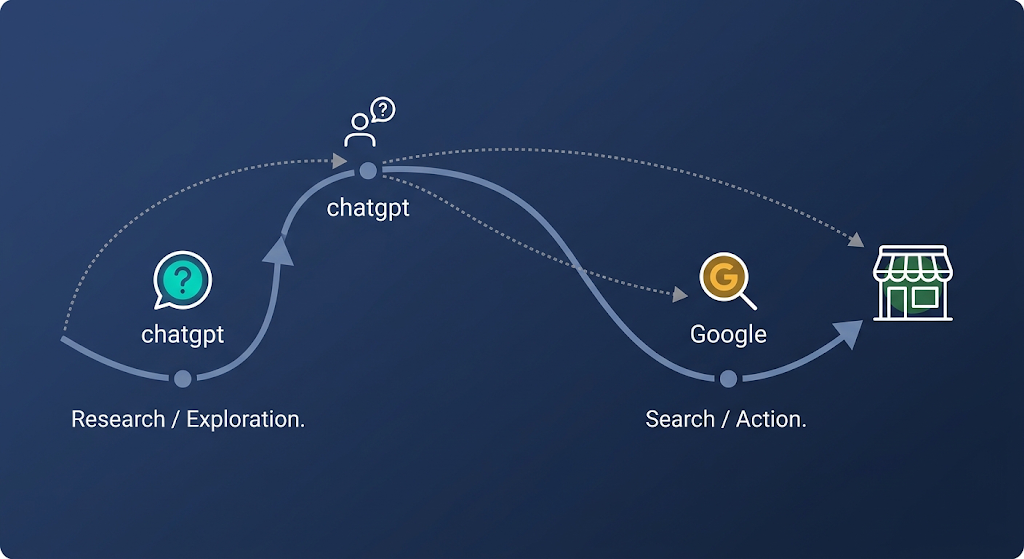
This is not a weakness in ChatGPT Ads it is a different kind of opportunity. A business that appears during the research phase, before the customer has decided to search Google, can shape the consideration set before Google Ads even enter the picture. Whether that early-funnel reach converts at the same rate as a Google search click depends on the business type, the query, and factors that have not yet been publicly measured.
A simple intent comparison:
| Scenario | Likely platform | Intent signal |
|---|---|---|
| “Emergency plumber Waterbury CT” | Immediate, action-ready | |
| “How do I know if I need a plumber?” | ChatGPT | Exploratory, pre-decision |
| “Best accountants in Norwalk” | Comparison, near-decision | |
| “What does an accountant actually do for a small business?” | ChatGPT | Educational, early-stage |
| “HVAC company near me” | Local, action-ready | |
| “Should I repair or replace my HVAC system?” | ChatGPT | Research, before local search |
The same customer may use both platforms in the same decision asking ChatGPT to understand the options, then searching Google to find a specific business to call.
What Google Ads Does Well for Local Service Businesses
Google Ads has several advantages that come from two decades of operation and from the nature of search intent.
Declared intent at the moment of need
A person who types a local service query into Google is usually ready to contact a business. The intent is specific and the timing is immediate. For emergency services, seasonal demand, and one-time project inquiries, this is valuable.
Established measurement
Google Ads connects to Google Analytics 4, to call tracking, and to form submission events. The path from ad click to phone call or form submission can be tracked and attributed. A business running Google Ads for more than a few months typically has a cost-per-lead figure it can compare against other channels.
Geographic targeting
Google Ads allows precise radius targeting, zip code exclusions, and “people in or regularly in” location settings. For a Danbury landscaping company that serves specific towns, this matters. A platform without granular geographic targeting reaches people who cannot become customers.
Local intent amplification
Searches that include a town name, “near me,” or similar local signals produce results weighted toward local businesses. For a Waterbury dental practice or a New Britain contractor, this means the audience is pre-filtered by geography before the ad even appears.
What ChatGPT Ads Does Differently
ChatGPT Ads is not trying to replicate Google Ads in a different interface. The channel has characteristics that are genuinely different, not simply inferior.
Reach at the research stage
If a potential customer asks ChatGPT a question about home repair, landscaping, or financial planning before they ever open Google, an ad in ChatGPT reaches them at a stage where the Google auction has not yet started. Whether that early-funnel exposure converts into a customer is a question that does not yet have a published answer, but it is a different moment than Google captures.
Conversational context
A ChatGPT query typically includes more context than a Google search. “I have an older home in Connecticut with outdated electrical and I’m worried about safety” is a more detailed signal than “electrician near me.” A well-configured ChatGPT ad can appear in response to a richer description of a need.
Lower paid competition in many categories
According to Floodlight’s field research on 550 live ChatGPT queries run between May and June 2026, 84% returned no ads. This means most categories currently have little paid competition in ChatGPT. Early advertisers in a category face less auction pressure than they typically would on Google for the same type of query.
A lower-cost starting point for some businesses
OpenAI has not published pricing tiers for ChatGPT Ads. Without confirmed data, any specific cost comparison is speculation. What can be said is that early-stage ad platforms have historically offered lower costs than established ones before competition drives prices up but that pattern does not guarantee any particular outcome here.
ChatGPT Ads vs Google Ads: What Is Not Yet Known
This section matters because a lot of coverage of ChatGPT Ads fills in gaps with optimistic assumptions. Here is what the public record does not yet include.
Comparative performance data
OpenAI has not published data showing how ChatGPT Ads perform against Google Ads in cost-per-lead, conversion rate, or return on ad spend for local service businesses. Any specific claim comparing the two on these metrics is not based on published data as of November 2026.
Geographic targeting depth
Google Ads allows radius targeting and zip code exclusions. The granularity of ChatGPT Ads geographic targeting for local service businesses has not been publicly documented in the same detail. For a Norwalk contractor who does not serve New York, this matters before committing budget.
Attribution clarity
Google Ads has a mature attribution model with multiple options and years of data to compare against. ChatGPT Ads is building that infrastructure. Without clear attribution, it is harder to know whether a customer who saw a ChatGPT ad was influenced by it or would have found the business anyway.
Long-term cost trajectory
Whether ChatGPT Ads costs remain low as more advertisers join the platform is unknown. The 84% no-ads figure from Floodlight’s research reflects a moment in time, not a stable equilibrium.
A Decision Framework for Connecticut Small Businesses
Rather than recommending one channel over the other, the more useful question is which combination of characteristics describes the business.
| Business characteristic | Likely priority |
|---|---|
| Needs customers this month | Google Ads higher-intent, faster conversion cycle |
| Has no ad tracking in place | Neither until tracking is set up blind spend on either channel |
| Already runs Google Ads profitably | Consider testing ChatGPT Ads with a modest budget alongside |
| Early-stage brand with no search rankings | Google Ads first; ChatGPT Ads as a secondary test when budget allows |
| Services customers who research before calling | ChatGPT Ads worth testing conversational research is the entry point |
| Services customers with urgent, immediate needs | Google Ads more directly suited to the intent signal |
| Tight marketing budget | Google Ads first more established measurement reduces wasted spend |
None of these is a rule they are starting points for thinking about which channel aligns with how the business actually gets customers.
Running Both Channels at Once
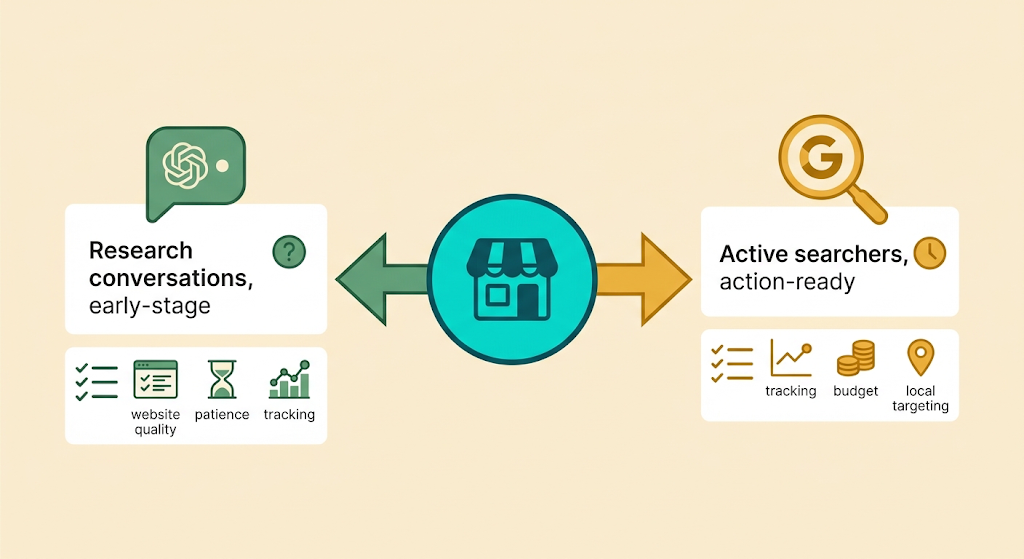
One framing the comparison creates is a false choice: Google Ads or ChatGPT Ads. For a business with the budget and tracking in place to test a new channel, running both simultaneously is a reasonable approach.
The practical structure is:
- Maintain Google Ads for the high-intent, action-ready queries where the channel is proven
- Test ChatGPT Ads with a modest portion of the total ad budget enough to generate data, not enough to affect the business if the results are unclear
- Use the same conversion tracking for both so the results are comparable
- Review after 60 to 90 days with enough data to draw a directional conclusion
The conversion tracking infrastructure is the same for both. A business that already has form submissions and phone clicks tracked through its Google Ads setup has the measurement in place to evaluate a ChatGPT Ads test with no additional setup.
FAQs
How do ChatGPT ads and Google Ads differ for a small business?
Google Ads reaches people actively searching with declared intent. ChatGPT Ads reaches people during conversational research that may happen before the Google search begins. Both can reach the same customer at different stages of the same decision.
Should a small business advertise on ChatGPT or Google?
For most local service businesses, Google Ads is the more established starting point with clearer measurement and more proven attribution. ChatGPT Ads is worth testing for businesses that already run Google Ads profitably and have conversion tracking in place. Neither replaces the other at this stage.
Is advertising on ChatGPT cheaper than Google Ads?
OpenAI has not published pricing tiers for ChatGPT Ads, so a direct cost comparison is not possible from public data. What is known is that according to Floodlight’s field research, 84% of ChatGPT queries returned no ads as of May-June 2026, suggesting most categories have low paid competition. Whether that translates to lower costs, and for how long, is not yet documented.
Can I track results from ChatGPT Ads the same way I track Google Ads?
ChatGPT Ads is building its measurement infrastructure. Google Ads has years of attribution data, multiple attribution models, and integration with Google Analytics 4. The measurement gap is real and means that results from a ChatGPT Ads test may be harder to attribute with confidence than results from an established Google Ads campaign.
Does Google Ads still work for local service businesses in 2026?
Yes. Google Ads continues to reach local searchers, with paid placements operating separately from AI-generated organic results. The changes affecting organic SEO are in our AI Max for Search guide.
What should I do before testing ChatGPT Ads?
Three things: confirm that Google Ads conversion tracking is working correctly so there is a baseline to compare against; review the website for speed, clarity, and a clear contact method; and set a specific test budget and time window so the test produces a readable result rather than a gradual drain on the total budget.
Conclusion
ChatGPT ads vs Google Ads is not a verdict question yet not because either channel is irrelevant, but because the data needed to make a confident comparative case does not exist in the public record as of November 2026. What can be said with confidence is that the two channels reach users at different stages of a decision, that Google Ads has the more established measurement infrastructure, and that ChatGPT Ads is early-stage with low paid competition in many categories.
For Connecticut businesses in Waterbury, Norwalk, Danbury, New Britain, and surrounding areas, Lorphic’s Google Ads management address the foundation. The broader context for how AI is changing advertising is in our advertising in AI chatbots guide. Current options are at lorphic.com/deal.
Curated by Lorphic
Digital intelligence. Clarity. Truth.