

Is AI-generated content bad for SEO? No. Google does not penalize content because it was created with AI. Google’s official position, stated in their guidance on AI-generated content and confirmed repeatedly by Search Advocate John Mueller: “Our focus is on the quality of content, rather than how content is produced.” Content that is helpful, accurate, and created for people ranks well regardless of whether a human or an AI wrote the first draft. According to a 2026 Ahrefs study, 81.9% of top-ranking Google search results are moderately to heavily AI-assisted. AI content is not bad for SEO. Bad content is bad for SEO, whether a human or an AI produces it.
The fear that AI-generated content is bad for SEO comes from 3 real but misunderstood issues: Google’s spam policy against “scaled content abuse” (which targets mass-produced low-quality content, not AI usage itself), high-profile manual penalties on sites using AI to fake human authorship (a deception penalty, not an AI penalty), and the persistent myth that Google can detect and penalize all AI content (it cannot, and it has stated it does not try to). This guide separates the 7 facts from the myths with direct citations from Google’s own documentation.
Key Takeaways
- AI-generated content is NOT bad for SEO. Google does not penalize content for being AI-generated. Google penalizes content for being low-quality, unhelpful, or manipulative regardless of how it was created.
- Google’s official position: “Our focus is on the quality of content, rather than how content is produced.” This is stated in their helpful content guidelines and confirmed by Search Advocate John Mueller.
- According to Ahrefs 2026, 81.9% of top-ranking Google results are moderately to heavily AI-assisted. AI content already dominates the top of search results.
- What Google DOES penalize: “scaled content abuse” (mass-producing low-quality content to manipulate rankings), fake authorship (AI-generated bios, made-up credentials), and thin content that adds no value.
- The correlation between AI detection score and Google ranking is 0.011 (essentially zero). AI detection scores have no measurable impact on rankings.
- At $15/hour, Lorphic uses AI tools to enhance content production while ensuring every piece meets Google’s quality standards through human review and editing.
Table of Contents
- Google’s Official Position on AI Content
- Myth 1: Google Penalizes All AI Content
- Myth 2: Google Can Detect AI Content and Derank It
- Myth 3: AI Content Cannot Rank on Page 1
- What Google Actually Penalizes (It Is Not AI)
- When AI Content IS Bad for SEO
- When AI Content Is Good for SEO
- The 7 Facts vs 7 Myths Summary
- Decision Framework: How to Use AI for SEO Safely
- How Lorphic Uses AI in Content Production
- FAQs About AI-Generated Content and SEO
Google’s Official Position on AI Content
Google has addressed AI-generated content directly in their official documentation. Here is what they have actually said, not what SEO influencers claim they said.
From Google’s helpful content guidelines: “However content is produced, those seeking success in Google Search should be looking to produce original, high-quality, people-first content demonstrating qualities E-E-A-T.”
From Google’s AI content guidance: “Appropriate use of AI or automation is not against our guidelines. This means that it is not used to generate content primarily to manipulate search rankings, which is against our spam policies.”
From Search Advocate John Mueller (multiple public statements): Google does not care how content is produced. Google cares whether content is helpful, accurate, and trustworthy.
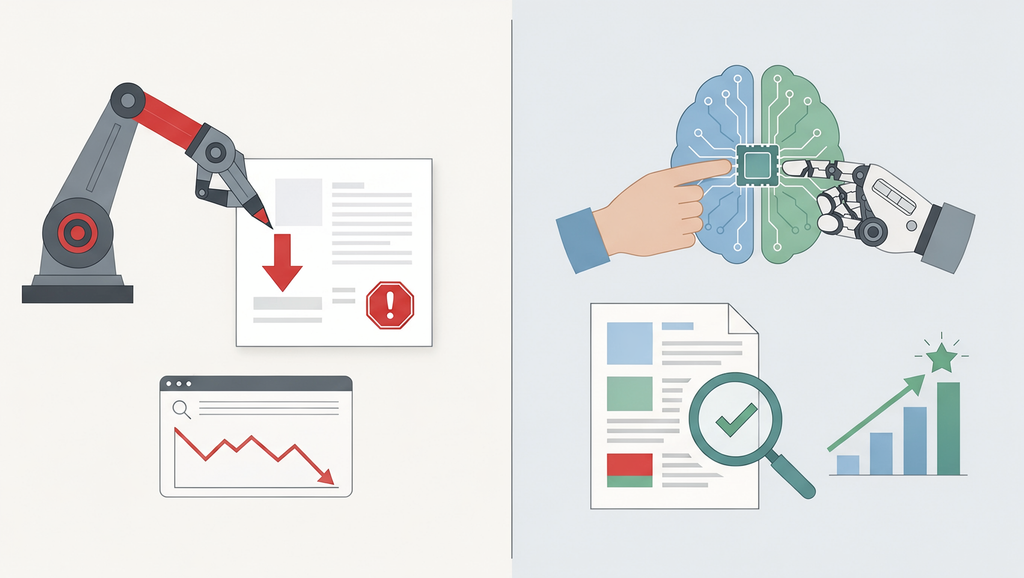
The position is clear: AI-generated content is not bad for SEO as a category. Low-quality content is bad for SEO as a category. The tool used to produce it is irrelevant to Google’s evaluation.
Myth 1: Google Penalizes All AI Content
The myth: “If Google detects your content was written by AI, it will penalize your website.”
The fact: Google has explicitly stated the opposite. There is no “AI penalty” in Google’s ranking algorithm. There is no sitewide downgrade for using AI tools. The idea that AI-generated content is bad for SEO because Google automatically penalizes it is false.
Google’s spam policies target specific behaviors, not tools. The scaled content abuse policy penalizes “generating large amounts of unoriginal content that provides little to no value to users.” This applies equally to human-written content farms and AI content farms. The penalty is for the behavior (mass-producing garbage), not the method (using AI).
What about manual penalties on AI sites? Yes, Google has issued manual penalties to sites using AI. But in every documented case, the penalty was for deception (fake authors, fake credentials, fake expertise), scaled abuse (thousands of near-identical low-quality pages), or thin content (no value-add over existing results). None were penalized simply for using AI.
Myth 2: Google Can Detect AI Content and Derank It
The myth: “Google has technology that detects AI content and automatically pushes it down in rankings.”
The fact: Google has not claimed to have or use AI detection technology in its ranking algorithm. According to multiple studies, the correlation between AI detection scores and Google rankings is 0.011, which is statistically zero. Pages scoring 100% AI on detection tools rank on page 1 alongside pages scoring 100% human. AI detection scores do not predict search rankings.
Google has stated that trying to detect whether content is AI-generated is not their approach. Their approach is evaluating whether content is helpful, regardless of origin. The claim that AI-generated content is bad for SEO because Google detects and demotes it has no supporting evidence.
Myth 3: AI Content Cannot Rank on Page 1
The myth: “AI-generated content cannot compete with human-written content in search rankings.”
The fact: According to the Ahrefs 2026 study, 81.9% of top-ranking Google search results are moderately to heavily AI-assisted. AI content is not struggling to rank. It already dominates the top positions.
The pages that rank on page 1 are not 100% raw AI output published without editing. They are AI-assisted pages that have been edited, fact-checked, enhanced with specific examples, and published with genuine expertise. The distinction is between “AI-generated and published as-is” (which often ranks poorly because the quality is poor) and “AI-assisted with human editing” (which ranks well because the quality is high).
AI-generated content is not bad for SEO when it is treated as a first draft that humans improve. It is bad for SEO when it is treated as a finished product that gets published without review.
What Google Actually Penalizes (It Is Not AI)
Google penalizes 4 specific behaviors. None of them are “using AI.”
Scaled content abuse
Publishing hundreds or thousands of pages with minimal unique value, whether generated by AI or humans. A site that publishes 500 AI-generated city pages with identical content except the city name swapped out is spam. The same tactic using human writers is equally spam.
Fake authorship and credentials
Creating AI-generated author bios with fake names, fake photos, and fake credentials. Google’s January 2025 Quality Rater Guidelines update specifically flagged “AI-generated headshots, made-up names or false credentials” as deception signals. This is a trust penalty, not an AI penalty.
Thin content with no added value
Pages that exist only to target a keyword without providing information the searcher cannot find elsewhere. AI makes it easy to produce thin content at scale, which is why AI sites get caught. But the penalty is for thin content, not for AI.
Manipulative intent
Content created primarily to manipulate search rankings rather than help users. Google’s helpful content system evaluates whether content was created for people or for search engines. AI content written to serve users ranks. AI content written to game rankings does not.
When AI Content IS Bad for SEO
AI-generated content IS bad for SEO in 5 specific scenarios. These are the legitimate risks.
| Scenario | Why It Hurts SEO | How to Avoid It |
|---|---|---|
| Published without human review | Factual errors, hallucinations, outdated information damage trust and accuracy | Always fact-check and edit before publishing |
| Mass-produced at scale without quality control | Triggers scaled content abuse penalties | Publish fewer, higher-quality pieces |
| Uses fake author bios or credentials | Triggers deception penalties | Use real authors with real credentials |
| Identical to existing content (no unique value) | Treated as thin content; will not rank | Add unique insights, examples, data, and experience |
| Generated to manipulate rankings, not help users | Targeted by helpful content system | Write for the reader first, search engines second |
The pattern: AI-generated content is bad for SEO when it is used irresponsibly. It is not bad for SEO when it is used as a production tool within a quality-focused workflow.
When AI Content Is Good for SEO
AI-generated content is GOOD for SEO when used correctly. Here is how the top-performing sites use AI.
AI for research and outlining. Use AI to research topics, identify subtopics, and structure content outlines. The AI accelerates the planning phase. Humans provide the expertise and unique angle.
AI for first drafts. Use AI to generate a first draft that covers the topic comprehensively. Then edit for voice, accuracy, specifics, and experience signals. The AI saves 40% to 60% of writing time. The human editing adds the quality that ranks.
AI for data analysis. Use AI to analyze keyword data, competitor content, and performance metrics. The AI processes data faster. The human interprets it and makes strategic decisions.
AI for content variations. Use AI to generate email subject line options, social media captions, ad copy variations, and meta description alternatives. The AI produces volume. The human selects the best options.
AI for content refreshing. Use AI to update outdated blog posts with current information, improved structure, and better formatting. The AI handles the rewrite. The human verifies accuracy and adds new insights.
The 7 Facts vs 7 Myths Summary
| # | Myth | Fact |
|---|---|---|
| 1 | Google penalizes all AI content | Google penalizes low-quality content regardless of origin |
| 2 | Google can detect AI and derank it | Correlation between AI detection and ranking is 0.011 (zero) |
| 3 | AI content cannot rank on page 1 | 81.9% of top results are AI-assisted (Ahrefs 2026) |
| 4 | AI content always triggers spam penalties | Spam penalties target behavior (scale, deception), not tools |
| 5 | You need to pass AI detectors to rank | AI detection scores have no measurable impact on rankings |
| 6 | Google is building an AI content penalty | Google says “our focus is on quality, not how content is produced” |
| 7 | Human content always outranks AI content | Quality determines ranking, not authorship method |
Decision Framework: How to Use AI for SEO Safely
| Do This | Do Not Do This |
|---|---|
| Use AI for first drafts, then edit thoroughly | Publish raw AI output without review |
| Add unique insights, real examples, and experience | Republish information available on 100 other sites |
| Fact-check every claim, stat, and recommendation | Trust AI output without verification |
| Use real author names and credentials | Create fake bios with AI-generated photos |
| Publish 2 to 4 high-quality pieces per week | Publish 20 low-quality pieces per day |
| Write for the reader, optimize for search second | Write primarily to manipulate rankings |
| Add original data, screenshots, case studies | Produce generic content with no unique value |
| Treat AI as a tool in a human-led workflow | Treat AI as a replacement for human judgment |
How Lorphic Uses AI in Content Production
Lorphic is a digital marketing agency based in Guilford, Connecticut that uses AI tools as part of a human-led content production workflow. The agency’s $15/hour pricing model means AI efficiency gains translate directly into more output per dollar for clients.
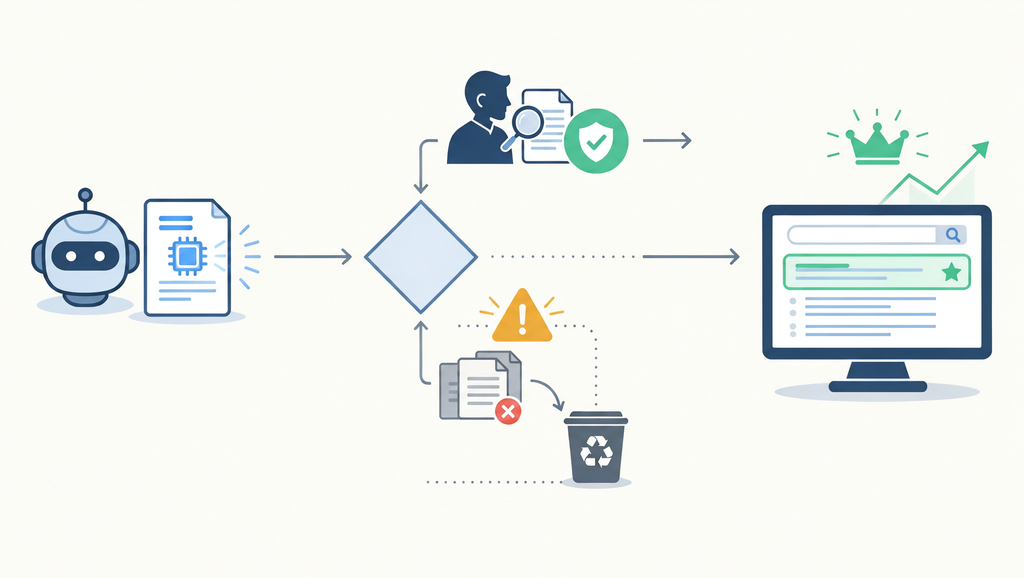
The workflow: AI assists with research, keyword analysis, content outlining, and first-draft generation. Human editors review every piece for factual accuracy, brand voice, specific examples, and E-E-A-T signals before publication. No content is published without human review. The result: content that meets SEO quality standards, satisfies on-page optimization requirements, and reads like an expert wrote it.
This approach proves that AI-generated content is not bad for SEO when the production process prioritizes quality. Lorphic coordinates content production with keyword research, local SEO, Google Business Profile management, social media marketing, and video production.
Resources are on the blog, with a free consultation and complimentary website report available.
Frequently Asked Questions About AI-Generated Content and SEO
Is AI-generated content bad for SEO?
No. Google does not penalize content because it was generated by AI. Google evaluates content on quality, helpfulness, and E-E-A-T signals regardless of how it was produced. AI-generated content that is helpful, accurate, and edited by humans ranks well. AI-generated content that is low-quality, mass-produced, or deceptive performs poorly, just like low-quality human content.
Does Google penalize AI content?
Google does not penalize content for being AI-generated. Google penalizes specific behaviors: scaled content abuse (mass-producing low-quality pages), fake authorship (AI-generated bios with false credentials), thin content (no unique value), and manipulative intent (content created to game rankings). These penalties apply equally to human-written and AI-generated content.
Can AI content rank on Google page 1?
Yes. According to a 2026 Ahrefs study, 81.9% of top-ranking Google search results are moderately to heavily AI-assisted. AI-assisted content that is edited, fact-checked, and enhanced with unique insights ranks on page 1 regularly. Raw, unedited AI output ranks poorly because the quality is typically insufficient, not because Google detects it as AI.
Does Google detect AI-generated content?
Google has not claimed to use AI detection technology in its ranking algorithm. The correlation between AI detection scores and search rankings is 0.011 (statistically zero). Google evaluates content quality, not content origin. AI detection tools exist (GPTZero, Originality.ai), but their scores do not affect Google rankings.
Should I use AI for SEO content?
Yes, within a quality-focused workflow. Use AI for research, outlining, first drafts, and content variations. Have humans edit for accuracy, voice, specifics, and experience signals. Fact-check every claim. Add unique insights. Publish under real authors with real credentials. This approach produces content that ranks well while reducing production time by 40% to 60%.
What type of AI content does Google penalize?
Google penalizes AI content that falls under “scaled content abuse”: mass-produced pages with minimal unique value created primarily to manipulate rankings. Google also penalizes content with fake authorship (AI-generated photos and bios) and content that is factually inaccurate or deceptive. The penalty targets the quality and intent, not the use of AI tools.
Curated by Lorphic
Digital intelligence. Clarity. Truth.